
 I’ve just been accepted into the august fold of East Anglian Writers so I guess that makes me a proper author. Cor blimey!
Category: East Anglia
Seaside Special
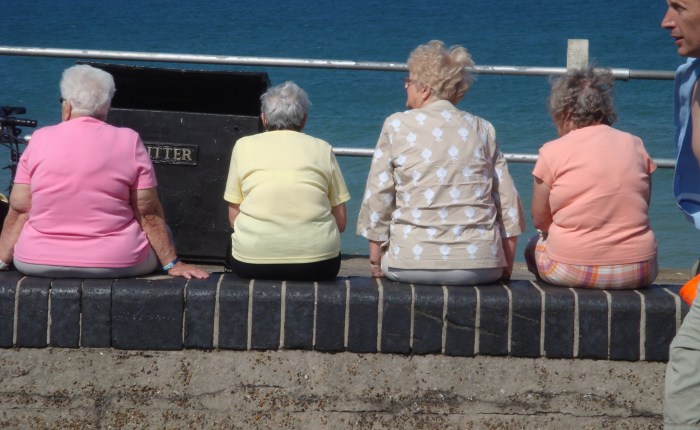
On those rare occasions when the sun comes out, the wildlife of Blighty flocks to the coast like migrating wildebeest. Not one to buck the national trend, Liam poked his toe out of the front door and decided a day trip was on the cards. He had Cromer in mind, a seaside resort on the north Norfolk coast. The town was in carnival mood and Liam fancied his chances in the knobbly knees contest. To my ear, Cromer sounds like it should be north of the border not north of Norwich. Half an hour across the flatlands, we reached our destination. An hour later, we managed to find somewhere to park. Cromer is a dainty and neat little place serving up the time-honoured seaside fare of battered fish, non-dairy ice cream, snotty sea food and cream teas on doilies. The town was packed to the rafters with day trippers getting in the way of these gay trippers. A bracing wind blew in from the bleak North Sea and crazy bathers braved the chilly waters. We were a long way from the fierce Meltemi Wind or the warm waters of the Aegean. The elusive festival was nowhere to be seen. Slightly dejected, I took Liam and his prize-less knees to the pub for a drink. I ordered a glass of white at the bar. The burly barman dressed in a riot of freshly-inked tattoos (just like the skies, tattoos are big in Norfolk) was having none of it. “We don’t sell wine by the glass,” he said in his farmer’s twang. The scary regulars stared on as they supped pints of the usual (whatever that was). That was that. Time gentlemen, please. As we headed back to the car, I caught a glimpse of a large fading poster flapping in the wind. Jimmy Cricket was the star turn at the end of the pier show. I thought he’d long since dropped off his perch. Perhaps it goes to prove that old jokers never die, they just go to Cromer. That’ll be me, then.
You might also like:
Spooks 2
Our tatty chattels finally made it across the high seas, landing safely at the port of Felixstowe in Suffolk. Her Maj’s Revenue and Customs eyed the consignment with cynical suspicion and decided to x-ray the boxes for contraband Turkish delight. This public service was provided at our expense, incurring a charge of £100. Isn’t this a bit like being frisked by the fuzz and paying for the privilege? The boys in blue found nothing untoward and the family silver was released. That was that, or so we naively thought.
We received word from the carriers that our precious cargo would be delivered by a 19 metre road train (their words) and if they couldn’t park within 15 metres of our new gaff we could kiss our goods goodbye (my words). When I pointed out that the medieval streets of old Norwich are characteristically narrow and that a 60 foot mega truck was a tad excessive for our modest six square metre load, they recanted and decided that a van of standard girth would suffice.
D Day arrived. The van pulled up outside and two large gentlemen swung into action, huffing and puffing as they piled the boxes into neat rows inside our new living room. The entire sweaty exercise was completed in under 30 minutes. As we unpacked each box, it was obvious that spooky hands had been fondling our family jewels. A shattered lamp emerged from one battered box. Glass fragments from the same lamp magically appeared in a different box.  Hey presto. The backs of photo frames had been removed and replaced with the clips left open (the same photo frames suffered the same fate when they delivered to Turkey four years previously). Most distressingly, the base of one of our tall super-sleek speakers had been hack-sawed off and the broken thread lay discarded at the bottom of the box. Just as well we smuggled out the rechargeable marital aids in our hand luggage. Clearly, this bump and grind was much more than a bit of rough handling by a hairy docker. Who would have thought?
You might also like:
Size Really Matters
 Conversation on BBC Look East a few minutes ago:
Commentator: “What does it take to be a great cox?”
Expert: “Size really matters.”
Amen to that.
The Voice Hits Pontin’s
 Back at base camp, we donned our glad rags and pirouetted down to the Stardust Cabaret Bar (think swirly carpets and swirly ceilings) to watch the permanently smiling bluecoats strut their amateur stuff. We were greeted by pissed-up pensioners and sprightly sprogs. As far as we could tell, we were the only wooly-woofters in wonderland (apart from a light fairy dusting from one or two of the bluecoats, obviously). We’d arrived at the tail end of a line dancing hour and sat back to marvel at a small company of wrinklies giving their pacemakers a welcome workout. The dosey doe harmonies were supplied by one woman and her magnificent organ. I ordered a couple of drinks from a barmaid called Richard. She’d mislaid her badge, apparently. Taking a table next to a couple of senior citizens, we nodded a polite (if slightly nervous) hello. We needn’t have bothered. Mr Senior had already nodded off into his half-pint of ‘mild’. Mrs Senior made no attempt to check for a pulse so we guessed he hadn’t yet expired. “That’ll be us in twenty years,” whispered. Liam. “You’re kidding,” I replied. “That’s us now.”
The headline act was local lass Toni Warne, a finalist from the BBC show The Voice. Liam could hardly contain his excitement. As he shivered in anticipation, the dressing room door inexplicably blew open to reveal a startled MC sucking on an illicit fag. Once recomposed, the camp compere minced out onto the floor to introduce the star turn. “Please give it up for Toni Ward.” Ms Warne didn’t let his faux pas get her down and belted out a string of old standards and modern classics from Doris Day and Barbra Streisand to Adele and Jessie J, all bang in tune. Mrs Senior turned down her hearing aid I suspect she and the rest of the audience would have preferred a spot of Vera Lynn. Liam thought Ms Warne had a great voice for musical theatre. I felt rather sorry for her. I thought aspiring stars gigged at Pontin’s before making it big, not after.
Despite the so-so weather and jaded Seventies social club ambience, we rather enjoyed our windswept blast from the past. Thank you, Pontin’s. You perked up these weary travelling pansies and provided a quiet place to rest and write.
You might also like:
Devil Gate Drive
We made our great escape from Stalag 17 and dashed to Morrison’s Supermarket to stock up on cheap plonk, check prices and observe the local Suffolk wildlife in its natural habitat. The place was packed. It may have been a Sunday but Brits have long since abandoned praying for paying on the Sabbath. Despite many protestations to the contrary, we found prices more than comparable with Turkey, particularly meat, staples and non-food essentials. While Liam stalked the aisles for bargains, I went in search of a decent newspaper. Morrison’s sold neither the Guardian nor the Independent so I made do with the murky Murdoch’s Times. The queue was fronted by a Suzi Quatro looky-likey, all feather cut, tight ribbed vest and rock-chick tattoos. Suzi was in a heated debate with the check-out assistant, something about a pot plant. I didn’t intrude. I didn’t fancy a volley of expletives from the girl from Devil Gate Drive. We fled back to our bunker to get drunk.
Hit it Suzi…
 You might also like Every Little Helps
Next: The Voice Hits Pontins
Pontin’s Happy Campers
 The final leg of our budget trip was four nights at Pontin’s, Pakefield – seventy quid each, half board. Both Liam and I are well-acquainted with the holiday camp experience from our proletarian childhoods and, more recently, from my mother’s 80th birthday bash at Butlin’s. Whereas Butlin’s has raised its game to compete with the costas, Pontin’s has remained faithful to its Hi-Di-Hi roots. There have been some concessions to the modern era – our bunker in Pirouette Park came with hot water and electricity – but the rest of the offer was distinctly old hat. Accommodation came in terraced rows of jerry-built chalets reminiscent of a prisoner of war camp or a sleazy middle America motel. We felt like fugitives on the run from the Feds. Higgledy-piggledy pebble-dashed facilities were battered and tattered. Canteen times were fixed and uncompromising. Food was hearty rather than wholesome with a strong whiff of time-honoured old school dinners. There was a floppy salad bar and a sign warning the punters that “these trays may contain traces of food.” Or was that nuts? We avoided the healthy option and headed straight for the stodge slopped up onto mini plates by fiercesome-looking dinner ladies. On day two, I was unceremoniously ram-raided by a blue rinse armed with a killer Zimmer trying to get to the jelly before anyone else. In the interests of personal safety, we didn’t dare go for seconds. Oh, happy days.
You might also like – Hi-Di-Hi
Windy City
 The minor inconvenience of existing tenants meant that we had to wait a while for our medieval Weaver’s cottage in Norwich. To avoid continual sofa-hopping, we decided on a budget tour of east East Anglia. Our first stop was Lowestoft, England’s most easterly town. We were greeted by blustery squalls blowing in from the North Sea and a large ugly concrete water tower (can someone tell me what they’re for?). Lowestoft itself is a neat but empty little place. The population seemed to have died off from terminal boredom. The only person we noticed strolling along the prom was a bottle-blond Norfolk broad, subtly bedecked in hoop ear-rings, stars-and-stripes lycra leggings and a bubble jacket. We booked a cheap night in a Winelodge. The solitary person on duty was a thin, tattooed boy with retreating hair. He acted as concierge, waiter and barman. It was just as well there was nobody to serve. Our room was a designer postage stamp overlooking the bins. Making a cuppa was a delicate operation: the mini-kettle was so close to the mini-flat screen TV, I thought the steam might blow it up. The only excitement was a power cut at 7am. I had to dump and douche in the dark. The first person on duty fed the meter and lo, let there be light.
 We took a drive through Great Yarmouth, a sad and rusty little place with a magnificent beach but its greatness firmly behind it. Despite being Liam’s playground of choice as a slip of a lad, we decided against stopping for a windy trip down memory lane. Apparently, Yarmouth is one of the most deprived areas of East Anglia. The great and good of the county have decided that granting a licence for a super casino will provide the answer to a fed-up seaside resort on its knees. Las Vegas-on-Sea? The entire concept reminded me of Edmonton Green Shopping Centre near Liam’s folks, a tired little enclave where the betting shop is next to the pawnbrokers.
Next…
We’re All Immigrants Really
 I recently tuned in to a debate on BBC Radio Norwich. It was about immigration, something of a national obsession in Britain. Some of the comments were intelligent and thoughtful, others were plain stupid. It made me think. How is it that, in general, relatively rich people from the West who move abroad are described as ‘expats’ whereas relatively poor people settling in the West are classed as ‘immigrants’? Perhaps this is because ‘immigrant’ is a dirty word these days, laced with nasty undertones of freeloading and coloured by thinly veiled racism. The threat of the UK or anywhere else being swamped with lazy foreign devils sponging off the state and plotting a new world order is a tad exaggerated in my experience. Where would the National Health Service or the care sector be without imported labour? It’s also worth bearing in mind the United Nations of young people who greet the commuting worker bees of London at the Pret a Manger* counter each morning are there because they’re eager, committed and willing – not a scrounger among them. This is an attitude that some British youths would do well to emulate.
 The smug, self-congratulatory term ‘expat’ does have more than a hint of the British Raj about it (or any colonial raj come to that) – people who move away for a sea-view room or a tax-free dream job but who maintain their cultural and language separateness in various expat ghettos across the globe. The word also suggests a sense of impermanence. Interestingly though, many foreign nationals I know in Turkey have no intention of moving back to their home countries. Some have even acquired Turkish citizenship (though I suspect few have relinquished their original passports. It pays to have a plan B, just in case). If expat life is transitory does this mean that immigration is permanent? This doesn’t explain the huge influx of Poles who moved to Britain in the 90’s looking for work, many of whom have since moved back to Poland because the work dried up. They are called immigrants (and less savoury words by some). Clearly, quite a few have no wish to stay longer than necessary. Perhaps it really is all to do with the filthy lucre.
It’s certainly true that expats tend to be more financially self-sufficient than those who move in search of a better economic life, but nothing is that simple. In Turkey, plunging interest rates in recent years have presented quite a fiscal challenge to those trying to maintain a hedonistic lifestyle on dwindling assets. I wonder how many will survive? In the end, some may have to head home anyway, kicking and screaming. Expat? Immigrant? You say tomayto, I say tomarto.
*Pret is very successful British coffee and sandwich chain. I recommend their breakfast baguette – delish!
‘Allo, ‘Allo Norwich
 Throughout the Middle Ages, Norwich was England’s largest city outside London and, until the eighteenth century, vied with Bristol to be the Sceptered Isle’s second metropolis. The original source of the city’s wealth was the wool trade (England’s principle foreign exchange earner in those far flung days). As the industrial revolution swept through other parts of the country, Norwich slipped down the civic rankings. The city was relatively untroubled by industrialisation and avoided most of the urban blight that followed it. Much of what did exist was flattened by the Luftwaffe in 1942. The blanket bombing was a bit of threadbare affair as the Jerrys missed both the enormous city hall and Jeremiah Colman’s mustard mill. Despite the bulldozing frenzy of the 60s and 70s that disfigured too many British towns, Norwich has managed to preserve much of its charming medieval legacy.
Apparently, Jeremiah Colman was one of those rare Victorian philanthropists who were good to their workers. This goes to prove that you can get filthy rich without screwing the poor. Until recently, Colman’s was the main sponsor of Norwich City Football Club. This crown has now passed to Delia Smith, Blighty’s most famous no-nonsense cook and obsessive football fan. However, St Delia (as she’s known in the pie trade) is not a local lass. Norwich’s most famous daughter is Edith Cavell. Nurse Cavell was shot for treason by the dastardly Germans in the Great War because she helped smuggle British prisoners of war out of occupied Belgium. It caused an international outcry at the time and badly damaged Imperial Germany’s image. Well, it just wasn’t cricket and not nearly as funny as ‘Allo, ‘Allo.
Like anywhere, I’m sure it has its problems but Norwich today is a sparkling hilly liberal jewel within a flat sea of true blue conservatism. The council is Labour-controlled and the city returns two members to Parliament. The current incumbents – Simon Wright (Liberal Democrats) and Chloe Smith (Tory) both have progressive social views, including a healthy understanding of LGBT issues. Right on Norwich, here we are.
You might also like:
 Perking the Pansies