The main event on Aegina was recuperation and recharge. Once again, we stayed at the Bamboo Cottage in the lush and leafy grounds of the gorgeous Rastoni Hotel. Our cool and comfy terrace provided the perfect plot for reading, napping and gassing, dealing cards and enjoying a few trips around the Scrabble board, all washed down with cheap and cheerful local plonk. I beat Liam at seven-card gin rummy; he thrashed me at the wordy game. I suspect he cheated by swapping tiles while I was retrieving the wine from the fridge to refresh our glasses. He denied it, of course.
Early evenings were spent wandering around town poking our noses down alleys and browsing for tourist tat. Good-looking Aegina Town is stuffed with handsome pastel-painted neo-classical buildings and pretty churches. Occasionally, though, we’d stumble upon a tumbledown wreck in dire need of some TLC. Liam loves a doer-upper. It sets his pulse racing with ‘what ifs’.
All too soon it was over and it was back to Athens for one final night in the vibrant and captivating city of wisdom. It’s also the city of graffiti. Pretty much everything is tagged. After a while, you just stop noticing. And alongside the fancy bits, some of the buildings are a bit knackered. But we loved it anyway.
Like our first trip to Athens last year, our flight was delayed by an hour. But unlike our first trip, our passage through passport control at Athens Airport was a breeze. It was then déjà vu all the way to the Attalos Hotel, a short and sweaty case-wheeling stroll from Monastiraki Square, once the throbbing heart of Ottoman Athens. And it’s still throbbing today with a milling crowd of many nations. After dumping our belongings we headed straight up to the intimate rooftop bar with its jaw-dropping views of the Acropolis.
Last year we embarked on our very own Greek odyssey, taking in the ancient sites at Epidaurus, Mycenae, Olympia and Delphi. This time was more of a museum vibe. Our morning excursion was to the National Archaeological Museum, a neo-classical pile showcasing the best finds from Greece’s glorious past. There’s so much to see that it’s simply overwhelming.
Nevertheless, we were particularly drawn to the many faces from the past.
And the sculptures of butt-naked blokes went down well too judging by the throng of over-excited onlookers. Some statues had their meat and two veg intact, others not. In more modern times, many a male member was hacked off by buttoned-up curators, and sometimes, rather than being discarded, they were hidden away in secret museum collections. Imagine it, a pick-a-willy drawer in size order.
Of all the stunning exhibits, this was my favourite. Standing at just over two metres tall, the magnificent bronze ‘Jockey of Artemision’ is dated to around 150–140 BCE and was recovered from a shipwreck in 1926.
Our afternoon expedition was to the über-modern Acropolis Museum, nestled at the foot of the famous rock and built to house artefacts found on the citadel and the surrounding slopes, from the Greek Bronze Age to the Roman and Byzantine eras. It is, perhaps, the most beautiful museum I have ever visited. We were politely but firmly discouraged from taking pictures but I sneaked in a few of the ladies of old Athens anyway. I know, naughty Jack.
Having had our fill of ancient Athens, we café-crawled back to our hotel through modern Athens, stopping off at various watering holes along the way with a final snifter in the rooftop bar before our short-hop ferry to Aegina the following day for the next leg of our journey.
What’s a couple of loose-end gay boys to do on a hot and cloudless summer’s day in old London Town? Pub or palace? We tossed a coin. Tails for the pub, heads for the palace. Her Maj won, so off we went to visit the glorious Hampton Court Palace, which graces a pretty stretch of the River Thames, upstream from Richmond. It was Liam’s first time whereas I’m an old pro – I first visited as a wide-eyed lad.
Construction of the magnificent pile started in 1514 by Cardinal Wolsey, Henry VIII’s Lord Chancellor. For seven years Wolsey lavished vast sums, building a palace to match his ego and rival anything in Rome. Clever and ambitious, the so-called ‘butcher’s son’ from Suffolk rose through the ranks to a position of power second only to the King himself. However, for most, being in Henry’s orbit was as precarious at it was profitable. And being his chief minister was the most precarious of all. Top dog Henry, the old letch and all-round shit, was a notoriously demanding and unpredictable boss who always got his way. A fall from favour could cost you your head – literally.
When the cunning old cardinal’s Machiavellian ways failed to secure a papal annulment for Henry’s marriage to Catherine of Aragon, he sensed his days might be numbered. So he gifted Hampton Court to Henry as an expensive bung in a desperate attempt to save his own skin. It didn’t work. He was arrested anyway – on trumped-up charges of treason – but died horribly from dysentery before he found his too-clever-for-his-own-good head on the block.
And that’s how Henry got his Hampton Court.
These days, the Palace has a split personality, with a 17th-century Versailles-inspired extension grafted onto the Tudor carcass
We worked up quite a thirst wandering through the gates, galleries and grand halls, chambers, chapel and wine cellar. So obviously, after the palace came the pub.
We spent a sultry evening watching the sun set over Old Father Thames and mingling with the jolly young boozers supping outside the parade of riverside ale houses by Richmond Bridge. Cheers!
We’ve finally recovered from our latest Hellenic odyssey to pretty Paxos and the Venetian glory of Corfu Old Town. While old Blighty baked under cloudless skies, we basked in Greek heat around a warm pool topped off by ouzo-fuelled steamy evenings of mirth and hot gossip with our travel companions. Thank you, you know who you are. A memory to savour was watching England beat Norway at the footie. We joined the rowdy crowd of many nations squeezed into cafés along the Liston, Corfu’s iconic Parisian-inspired arcade. Business was brisk as the drinks kept clinking and the tills kept ringing. Let’s not dwell on England’s later defeat by Argentina.
As for the rest, I’ll let the snaps do the talking…
Thanks to ‘Linda’ our official royal photographer for most of the pics.
Given the scorcher at home, I fretted that our little plot might wilt in the relentless heat. I needn’t have worried. Our neighbour did a splendid job with the watering can. Thank you!
The final pitstop of our Victoria Wood jolly was in Lancaster, the county town of Lancashire. Our lodgings for the night were at the historic 17th-century Sun Hotel and Bar with fancy rooms. Like my creaking bones, the creaking floorboards gave its age away.
Founded as a Roman fort in the 1st century CE, the handsome city, stuffed with listed buildings, is wrapped around the medieval castle built on the Roman roots. For us, the castle – until recently a prison – was the main event. Unfortunately, many of the best bits were ‘guided tour only’. Still, an old cell block which currently hosts the Lancashire Police Museum was open to casual callers – a quick frisk by a burly screw* with a bulldog face not required. And instead of ‘porridge’ at His Majesty’s pleasure, it was coffee and cake in the sunny castle courtyard afterwards, then back to our digs for some excellent pub grub washed down with decent vino. Cheers!
*’Screw’ is slang for a prison guard. The term is thought to originate from the 19th century, when prison life was really grim. Back then, inmates were forced to perform gruelling and utterly pointless hard labour by turning a hand-crank for hours on end. Depending on their mood, guards could tighten or loosen the screw on the machine to make the wheel harder or easier to turn. Hence the possible origin of the word still used today.
The amazing comedy genius that was Victoria Wood died in 2016. It was a sad day. As I wrote at the time, ‘she kept me laughing through four decades’. And now through the fifth and heading for the sixth, I’m still laughing. When we heard that Tom MacRae, the brilliant writer behind the hugely successful stage musical Everybody’s Talking About Jamie, had written a story around some of Victoria Wood’s most iconic songs, I would have sold my soul to the Devil for a ticket.
Thankfully, Satan will have to wait a while longer to have his wicked way with me as we managed to pick up a couple of tickets the very moment they went on sale. The only slight bum note was that the show was debuting not in London’s glittering West End – not even in the not-so-glittering off-West End – but at The Victoria Wood Theatre, recently renamed in her honour. And where is this eponymous venue? Bowness-on-Windermere in the Lake District. So as it’s about 210 miles north as the crow flies, we decided to make a meal of it.
First up was a pitstop in London, staying in steamy King’s Cross on the hottest day of the year. This once sleazy part of town – all street walkers, drunks, druggies and down-and-outs – has been transformed in recent years and is now home to posh shops, fancy bars, over-priced eateries and the huge British Library. We thought we might sleep over at the glorious St Pancras Hotel but with rooms from 500 quid a night, we settled on a budget bed in Premier Inn instead.
We also thought we might enjoy a sherry or two in the local gay pub we used to frequent back in the day, assuming, like the area, it had been tarted up. But when we noticed it was hosting the ‘Big Bi Fun Club’ in the basement, we decided to wave goodbye to the good Bi’s. Some sleazy things never change, I’m delighted to say.
Whenever we’re in London for our regular rendezvous with nearest and dearest, we try to fit in something a little different. And what could be more different than riding the Mail Rail? Back in the day when people still wrote actual letters, traffic gridlock in the smoky city was holding up the King’s mail. It just wasn’t on. The solution? Build a mini railway beneath the congested streets. From 1927, the underground mail train ran from Paddington in the west to Whitechapel in the east before hitting the buffers in 2003.
But that wasn’t the end of the line. Some bright spark at Royal Mail saw an opportunity to make a few bob, and Mail Rail opened in 2017 as a visitor attraction. We thought we’d give it a whirl. As we rattled along the narrow tunnel in the toy town choo-choo, the old subterranean world of the postie was revealed with fascinating audio-visual displays projected onto the curved walls of long-abandoned platforms. Then, quite suddenly, we shuddered to a halt and were plunged into total darkness. ‘Attention! Attention! Power cut!’ bellowed a fella with a Cockney accent over the tannoy. Liam looked worried. ‘Only joking!’ It’s not a trip for the claustrophobic – or the long-legged.
Our final stop was a tour of the nearby Postal Museum. Apparently, mail first became a thing for that old letch and all-round shit, Henry VIII, as a kinda medieval pony express for royal dispatches. No Truth Social back then. The stables used by all the King’s horses were called ‘posts’ – hence the origin of the word we use today. Who knew?
Although I’m way too long in the tooth to have been a fan of Postman Pat, that evergreen kiddies cartoon from the eighties, the entire experience brought out the inner child (or geek) in me.
As is my wont, I bought not one but two fridge magnets in the gift shop. Liam shrugged and sighed, as usual. And then I picked up something to read around the pool for our forthcoming Greek odyssey – assuming it’s not buggered up by you know who’s current war.
I see some weird and wonderful stuff about Norwich and its long and glorious history. Perhaps the weirdest and most wonderful is about the city’s lost loos from Secret Norwich called ‘Spending a Penny’. For those beyond these shores who may not know, spending a penny is a polite euphemism for taking a pee. The phrase apparently dates from the 19th century, particularly the hugely popular 1851 Great Exhibition, when public toilets at the Crystal Palace required an old one-penny coin to use the lock-up. Where better than a gent’s loo to find a row of knobs?
Nowadays, public facilities are an endangered species. Most have been closed due to rising costs and ‘anti-social behaviour’ – I can’t imagine what that means – which is a bit of a drag for us old farts with dicky bladders, particularly when tottering home after one too many sherries. Ironically, urine-soaked streets after a night out on the lash is why public loos were opened in the first place. Not that we do that sort of thing, of course. We keep our knobs firmly under wraps. But that Tena Man moment edges ever closer.
Good old Norwich has been crowned the best place to live in the land for 2026 by The Sunday Times. Judges heaped praise on the city for its ‘historic character’ and ‘urban buzz’. No shit, Sherlock. Those in the know have known that for years. It was something that slapped us about the face when we first paddled up the River Wensum back in 2012.
As I wrote for the Visit Norwich City of Stories website back in the day…
And that’s how it happened. One heady afternoon in the garden of the Playhouse Theatre Bar, Jack and Liam found somewhere new to lay their hats. An offbeat, theatrical, cosmopolitan, romantic, open-minded and open-hearted place set beneath the true-blue skies of Norfolk. Norwich, a surprising city. A place to live and a place to start living.
We may now have moved 10 miles out for a semi-rural quieter life, but we still regularly hop on the bus into town to soak up the vibe – because we’re not dead yet.
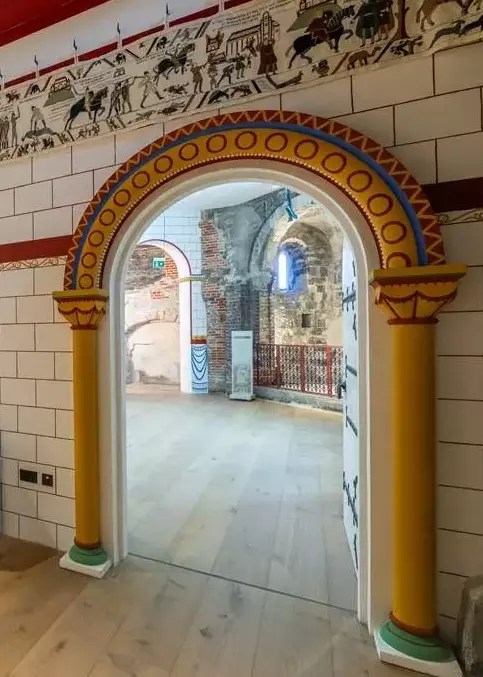
The last time we had a gander around Norwich Castle’s 900-year Norman keep, it was a hollowed-out shell. When converting the structure from a prison to a museum, the Victorians had ripped out the floors. The 19th-century look certainly had the wow factor and gave the structure a great sense of scale, but it lacked authenticity. Fast-forward to 2025 and, following a five-year, 27.5 million quid transformation by the Royal Palace Reborn Project, visitors can now explore five reinstated floors – from basement to battlements. So we reckoned it deserved a second viewing.
Alongside the remodelled keep, the castle features an assortment of galleries dedicated to local history. We really liked the exhibition dedicated to Boudica, the rebellious Queen of the Iceni who, between 60 and 61 CE, bloodied the noses of the perfidious Romans, torching the embryonic towns of Colchester, St. Albans and London along the way. In the end she and her rebels were crushed, but her heroic struggle has become the stuff of legends.
But we were really there for the main event – the new royal apartments dressed to impress in authentic 12th-century style when the keep was as much a palace as a fortress. What struck me was the gaudiness of the regal decor and trappings. I’ve always thought of the Middle Ages as being draped in drab and dirty earthy colours to match the short, sharp lives of the plebs. But, of course, we’re talking about those at the top of the heap. And what have they always done? Flaunt their wealth and power in glorious Technicolor.
As befits its high-end status, the residence came with all mod cons – a deep freshwater well and a less than freshwater communal toilet – a garderobe in castle-speak – where matters of state would be discussed over a bowel movement and the Groom of the King’s Stool might yell “garde à l’eau” – the possible origin of the modern word ‘loo’ – to unfortunate peasants passing by below.
We were particularly drawn to the centuries-old graffiti carved into the stone walls. Two examples stood out as most poignant: an image resembling a crucifixion in the shape of a St Andrew’s cross and a face of a woman in a wimple – possibly a nun – whose shiny image looks like it’s been buffed over and over again, perhaps by desperate souls seeking salvation before swinging from a rope. Both etchings speak of a time when, for 400 years, the castle was a prison.
We loved the experience and the excited sprogs around us loved it too. The whole show is a wonderfully vibrant way to bring history to life, for young and old alike.
Our last stop was a tour of the ramparts – opened up to the public for the first time. From here the punters get a tantalising glimpse of the modern city through the gaps – called crenels – between the raised stone blocks of the parapet. It screams “we’re in charge now and don’t you ever forget it”. Shame I left my longbow at home.
And to top it all, the museum is a finalist in the Art Fund Museum of the Year Award 2026. The winner will be announced on the 25th June at a ceremony at the Cutty Sark in London. Fingers crossed! 🤞