A few weeks back, I entered another writing competition with the marvellous ‘I Must Be Off!’ travel site. The piece is about Bodrum (naturally) and was adapted from my 2013 e-book ‘Turkey, Surviving the Expats‘. Somehow, my entry has made it to the last seven. Will I fall at the final fence? The competition is stiff so we shall see. Bronze, silver and gold will be announced at the end of the month. I’ve got my fingers crossed for my place on the podium. In the meantime, there’s a Reader’s Choice Award up for grabs too, based on the number of hits and comments. This award is open until the 10th August. Can I trouble you for a hit and a comment on the article itself by clicking on the link below? I thank you.
August 2014 Update: Yesterday, I received news that I’d come in first for the Reader’s Choice Award. A massive hand to anyone who took the trouble to visit and comment on the article. Thank you. I’m really chuffed!
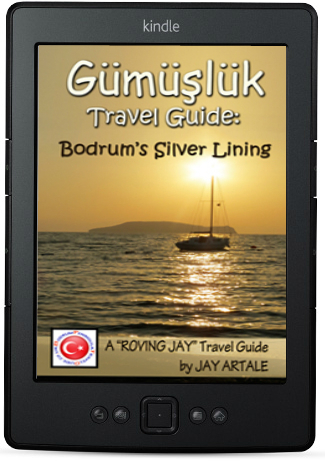
Roll, roll up for your free Kindle copy of the meticulously researched Gümüşlük Travel Guide: Bodrum’s Silver Lining by the incomparable Roving Jay. This one-time offer is available for two days only – the 7th and 8th of June – so grab it while you can.
The book in Roving Jay’s own words:
Whether you visit Gümüşlük for the day; make it your holiday destination; or plan on visiting long-term, the “Gümüşlük Travel Guide: Bodrum’s Silver Lining” provides you with all the information you need to discover this Turkish location for yourself.
I’ve thrown myself wholeheartedly into the process of writing this guidebook, and as well as gathering information, I’ve accumulated a collection of memorable moments along the way.
This is the start of your very own journey down the historical and well-trodden path to Gümüşlük and I trust my travel guide will help to create some unforgettable memories of your own.
Start creating those memories. Get the Gümüşlük Travel Guide at Amazon.co.uk | Amazon.com and all Amazon stores worldwide.
Oh, and I’m in it by the way, but don’t let that put you off.
A sunny spring day saw us on the top floor of a double decker cruising cross-country past gilded fields of rapeseed. We were on our way to Loddon, a picture postcard market town of 2,500 souls, ten miles outside Norwich at the headwaters of the Norfolk Broads on the River Chet. We had a taste for a speciality brew and a clotted cream fancy in the Vintage Tea Rooms at the eighteenth century mill, quite the thing to do in these parts. Neat and tidy Loddon is stuffed with quaint little Georgian and Victorian buildings lining its gently winding high street and is dominated by the fifteenth century Holy Trinity Church set in a sea of tombstones. The town also features the smallest fire station I’ve ever seen with room for just a single truck and no fireman’s pole to slide down.
We made it to the Vintage Tea Rooms, only to find it locked up with the following message:
“Closed for 2014”
We got the bus back to Norwich and went to the pub instead. Every cloud…
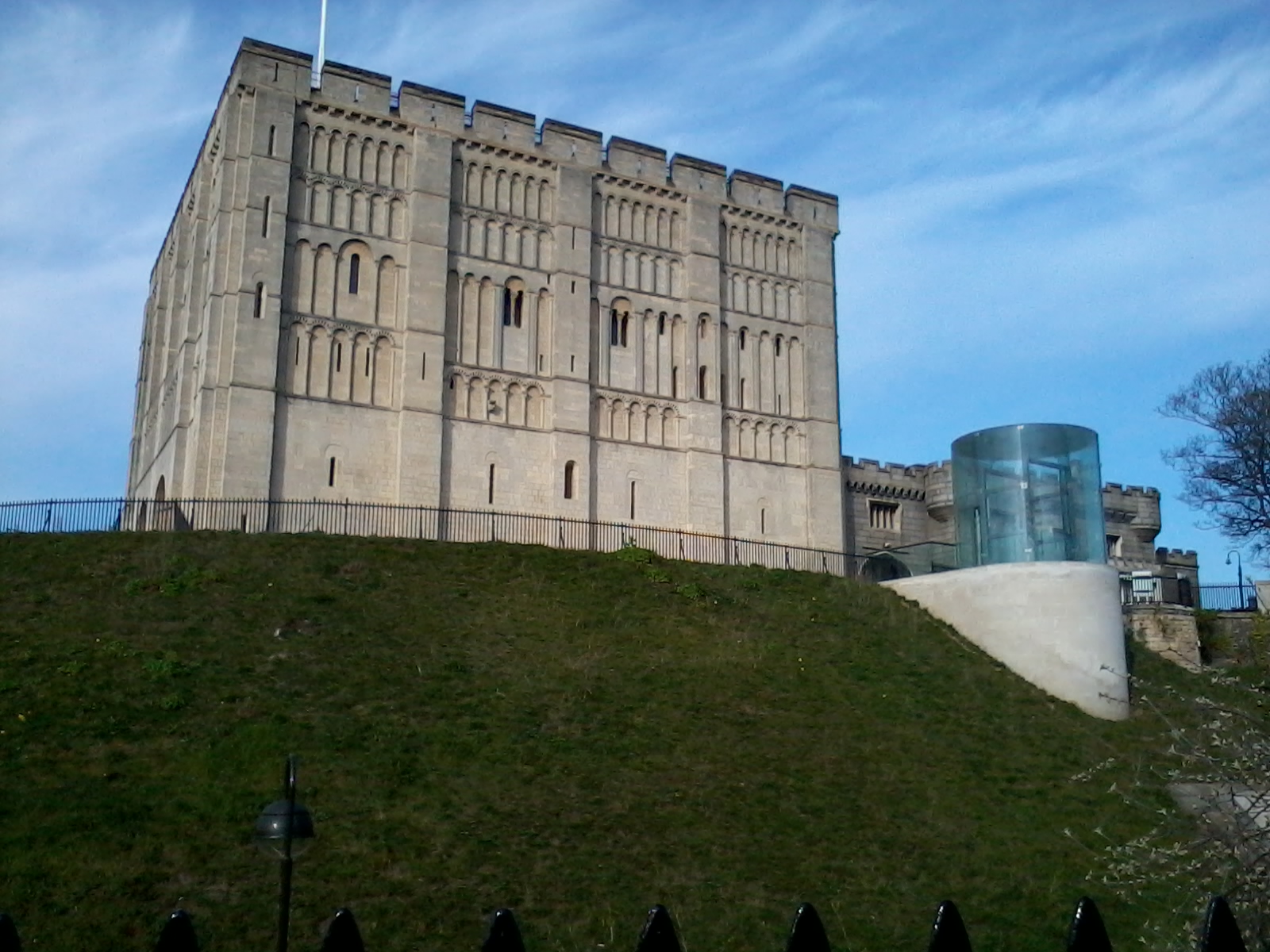
The great castle keep of Norwich dominates the city’s skyline. At first sight, it looks too twee to be authentic, its walls too sharp, its stonework too clean and its decoration too untroubled by the march of time. No wonder Liam and I assumed it to be a folly, a romantic Victorian nod to a more chivalrous age (if such a thing ever existed). As it happens, we were entirely wrong. While most of the sprawling castle has disappeared, the old keep and its handsome white Caen limestone walls have endured for almost 900 years. Its conversion from a royal palace to the county gaol in the 14th Century ensured its survival. The hanging, flogging and incarceration continued with great gusto for 500 years until the building opened as a museum in 1894. There’s a lesson there for us all: adapt to survive. I’d passed around the keep many times but had never bothered to pop in for a gander. That was until a new exhibition caught my eye – Roman Empire: Power and People – a British Museum tour. While the show didn’t quite match up to the scale and glory of the Ephesus Archaeological Museum in Selcuk (one of the highlights of our Turkey years) it was a beautifully formed diversion for a couple of hours on a crisp sunny day.
The remainder of the museum is given over to an assortment of galleries mostly dedicated to local history (Boudicca, Anglo-Saxon and Viking East Anglia, prison life). There’s even a small Egyptian gallery with its very own mummy (the excuse being that Howard Carter of King Tut fame grew up in nearby Swaffham). And only in England would you find a gallery dedicated to teapots – all 3000 of them. Sadly, the Teapot Gallery was closed (for a tea break, presumably). Generally, the exhibits had a school field trip about them. Oh to be twelve again. The keep itself is impressive and certainly wowed Liam. The Victorian renovators removed the cell blocks to open up the building’s shell and installed a galleried balcony at the level of the original Norman floor. Two massive arches support the roof. The ‘new’ look gives a real sense of the scale, something intended to send a powerful message to the defeated and downtrodden Anglo-Saxons in their tiny thatched hovels. The nasty Normans were saying, “We’re in charge and don’t forget it.” These days, aircraft carriers convey the same message.
After 20 months, we finally closed the door on the Weaver’s Cottage and left the old parish of Norwich-Over-The-Water. It was a sad parting but bricks and mortar are just that, even when they’re 370 years old and located in the oldest ward in town. In any case, we shall return. Our new gaff (my 18th home since I dropped) is less than a mile across the city on the other side of the water. We fully intend to re-visit our old haunts every now and then and wallow in the exuberance and pretentiousness of Norwich arty types (also known as a few pints on a warm summer’s evening at the Playhouse Theatre bar).
There’s something a little bit special about Norwich-Over-The-Water. It’s reckoned by those in the know to be the site of the original Saxon (or rather Anglish) settlement called Westwic. According to the Anglo-Saxon Chronicle, wood-pannelled Westwic was torched in 1004 by the deliciously named Sweyn Forkbeard, King of the Danes. Clearly there was something rotten in the State of Denmark, to misquote the Bard. However, the doughty arsonist’s marauding hit the right spot and he later became the first Danish king of England and introduced flat-packed furniture to a world-wide audience. Okay, I made that last bit up.
Fast forward to medieval times and Norwich-Over-The-Water welcomed Huguenot, Walloon and Flemish refugees from the near continent, fleeing religious persecution from the dastardly French and Spanish. The immigrants became known as “The Strangers” and eventually made up a third of the city’s population. Apparently, the mighty flood of immigrants caused very little resentment at the time. Far from packing out the workhouses and stealing the jobs of the local farmhands, the highly skilled expats from the Low Countries bolstered trade with mainland Europe and helped make Norwich rich. Stick that in your pipe and smoke it, Nigel Farage and your UKIP xenophobic swivel-eyed loons.
So, I give you a little tour of Norwich-Over-The-Water from the comfort of your own sofa:
On a recent trip down to the Smoke, Liam and I decided on a post-matinee snifter. We headed towards Trafalgar Square to the stage of our inaugural meeting, a chilly evening in the spring of 2006. The chance encounter is best described in my first book:
The rest, as they say, really is history.
As we hurried past the Sainsbury Wing of the National Gallery, we were confronted by the biggest cock I’ve ever seen, glowing bright blue in the late afternoon sunshine. It caused quite a stir, I can tell you.
Two cocks for the price of one
The puffed up rooster, by German sculptor, Katharina Fritsch, is the latest temporary exhibit on the empty corner plinth of the Square. The work is intended to poke fun at the vainglorious imperial statues of puffed-up men (Nelson, George IV, and generals Havelock and Napier) that surround it. There have been many fleeting displays on the podium down the years, from the daft to the inspirational, the profound to the whimsical. The reason there is no permanent statue has been an open secret for years. The plinth is reserved for an effigy of Her Maj after she drops off her throne. Given her mother’s longevity (the last Empress of India lived until she was 101), the chances are they’ll be a more temporary erections to come.
Back in Norwich, the cock of the coop theme continued.
Personally, I’d rather win a week in the Maldives but then, this is Norfolk, the nation’s bread basket and home to Bernard Matthews, king of the gobblers. It’s a funny old world.
Norwich is stuffed with the biggest, finest, oldest and firsts in all the realm. There’s a gem on virtually every corner. These are a few of my favourites. Hover over the image for a brief hint and click for more scintillating facts that you never knew you wanted to know.
The Millennium Library is a fitting successor to the first provincial municipal library – the most visited outside London. And guess what? They stock my book
The largest lips in the East and a great kisser
The only English example of a beguinage (a community of lay women living a life of poverty and chastity). The pretty thatched-roofed building is now the Briton’s Arms Restaurant
England’s most highly ornamented castle keep sitting atop England’s largest castle mound. Norwich Castle was founded a few years after the nasty Norman Conquest of 1066 when poor Harry got it in the eye. That happened to me once
The largest cathedral close in England and a great place for a picnic on a hot summer’s day
The only English city to have been excommunicated by the Pope when revolting peasants sacked the priory in 1274
Church of St John Maddermarket
The largest walled medieval city in England and bigger than the City of London. You need a vivid imagination – there’s little left of it now, more’s the pity
The first mass production of shoes in Britain – because life’s a catwalk
The first driving school in Britain opened in 1919. I could never be bothered to learn and relied on the kindness of strangers during my street walking days
The largest and most elaborate guildhall outside London. It’s rather dwarfed by the over-imposing and slightly Stalinistic Art Deco City Hall
England’s first provincial newspaper founded in 1701. It didn’t last long. The newspaper closed in 1713 after the Great Carrier Pigeon Hacking Scandal of 1712 (I’m kidding)
This is the rather over-imposing, slightly Stalinistic City Hall. The impressive building retains many of its original Art Deco features and has the longest balcony in Britain (at 365 feet). That’s the Catholic cathedral in the distance
The first and still only UNESCO World City of Literature in England
The first book written by a woman in the English Language came from the pen of Julian of Norwich in 1395. Strange name for a woman but, by all accounts, she was off with the fairies
The first blank verse to be published was written by Henry Howard, Earl of Surrey (eldest son to the Duke of Norfolk). Also, Harry and his mate Sir Tommy Wyatt were the first English poets to write in the sonnet form that Shakespeare later used. Harry didn’t make it to duke as the other Harry (that randy despot Henry VIII) had him beheaded for treason.
Rosary Cemetery was the first non-denominational cemetery in England where people of faith and people of none could together rest in peace
The only medieval friary to survive the Reformation intact – St Stephens and Blackfriars Halls are now used for all sorts of jollities including the annual beer fest piss-up
The largest cathedral cloister in England and very peaceful it is too
Lollards Pit is the only gay pub in the world to be found on the very site where heretics (the Lollards) were once burned to death. A delicious irony, don’t you think?
The first all-metal aeroplane in the world (1919)
Elm Hill is reputed to be the most complete medieval street in England, with buildings dating back to Tudor times. There’s not an elm tree to be seen, though.
The first municipal computer was delivered to Norwich City Hall in 1957 – with the brain power of a Casio pocket calculator (probably)
The Norman Cathedral is one of the most complete Romanesque buildings in Europe. That’s something to get down on your knees for
With thanks to Visit Norwich for much of this treasure trove.
Perking the Pansies recovered from a difficult birth at the murderous hands of the Turkish censors, thrived through the terrible twos and survived the transitional threes, ending the year with 60,000 hits for the last twelve months. Thank you to everyone and anyone who’s passed by and glanced at my random witterings. Most blogs burn out after two years so I must be living on borrowed time.
As the sun sets on 2013, in the best Hogmanay tradition, I give you the year’s top ten – a pick ‘n’mix treat of bum cleavage, Turks at the barricades, a shot in the arm, a tender coming out story, a sexy rugger bugger, a book to send you to sleep, an old-time boozer, an olive tree planted in a foreign field and a scratched itch.
Image courtesy of Occupy Gezi on Facebook.
One for the Ladies
The Art of Blogging at St Margaret’s Church of Art
A humble little post about a spectacular discovery in eastern Turkey that just keeps on giving while the archaeologists keep on digging – 8,000 hits and climbing. Who would have thought?
And what of 2014? All I know is that Turkey Street, Jack and Liam move to Bodrum will be out early in the year. Will it be as successful as the first one? Who knows? Not me. Whatever happens, come rain or shine, a happy and prosperous year to all my pansy fans. Thank you for staying the course and for your remarkable support. I’m touched but then, I have been for years.
I recently entered a travel writing contest. The piece was about my favourite part of Turkey, the Lycian coast. It’s not hugely detailed as I was limited to 1,000 words but I managed to pack a lot in. The entry was adapted from my recent e-book Turkey, Surviving the Expats. The last time I entered a similar contest (featuring my best bits of Istanbul, also lifted from the same e-book), I failed to win any gold stars. Boo hoo. Guess what? I didn’t win this time either. Boo hoo too. Mind you, the reference to wet dreams probably didn’t help.
So, ladies and gents, I give you my Highlights of Lycia, the article that didn’t win a bean. Never mind, I like it anyway and I hope you do too.
Postscript
I later found out that my article did, in fact, make it in to the top twenty and I won a prize – Worlds Apart by Smitha Murthy and Dorothee Lang. The book arrived today (8th October). Thank you!