Some Bodrum Belles of our acquaintance have been living hereabouts for a couple of decades (or more). They tell of cold water flats, power supplied on a wing and a prayer, a town virtually devoid of modern conveniences and fun, lots of it. Bodrum was where the intelligentsia was exiled and where the artistic found sanctuary. It was far enough away from Ankara to stay under the radar of the more reactionary tendencies of the ruling elite. Even today, Bodrum has a diverse, edgy vibe unique in all of Turkey. This is why we chose it. Ambling along the newly marbled streets lined by fancy bars crammed with the well-heeled, it’s hard to imagine how it must have looked in times past. Imagine no longer. Here are some old grainy snaps of the town. The last two images are of the lane that runs along the side of our house – then and now.
This slideshow requires JavaScript.
A curiosity is the Greek Orthodox Church that once stood in the heart of the town (first two pictures in the sequence). It’s a reminder of Bodrum’s Greek past before the euphemistically called ‘population exchange’ of 1923. Liam and I debated what now stands in its place. We think it’s the rather large and ugly concrete library. Perhaps those in the know could help us out.
Postscript
There’s a fabulous Facebook group page dedictated to old images of Bodrum places and people called Eski Bodrum. It’s a fascinating study in social history. Thanks to Back to Bodrum for the heads up.
Let’s face it, not many people can claim to live on the same street as one of the Seven Wonders of the Ancient World. No trip to Bodrum is complete without a look around the meagre ruins of the once magnificent Mausoleum of Halicarnassus (Bodrum that was) which are located a few hundred metres from our house. The vast tomb was constructed to inter the remains of King Mausolus in 350 BC (hence the origin of the word mausoleum). Remarkably, the monument survived virtually intact for seventeen centuries before it was felled by an earthquake in the middle ages. What remained was plundered by the Knights of St John to build the imposing crusader castle that now dominates the town. The fortress rises above the same strategic promontory where Mausolus’ palace once stood.
Admittedly, visitors need a vivid imagination to visualise how the monument once looked. All that really remains is a large hole in the ground with multiple fragments of pillars and dressed stones scattered about randomly. There is a bijou and rather tired museum which attempts to fill in some of the detail. It features a naff video on a loop: more of a tourist board advert for Bodrum. Typically, there’s more to be seen in the British Museum in London.
This slideshow requires JavaScript.
Still, there’s something about the place. A pretty overgrown precinct provides a welcome tranquil respite from the heat, hassle and bustle of the modern town. We visited on a sunny spring day. The shrubbery was verdant and winter waters still trickled through the foundations covering the stones with algae and creating a pool in Mausolus’ burial chamber. It was teeming with tadpoles and other pond life. After an hour or so tumbling over the ruins, we popped home for a welcome cuppa.
The Turkish oil wrestling circus came to an ancient town. A picnic field near the obscure and little excavated Lelegian city of Pedasa, high in the hills above Bodrum, hosted a greasy competition of brute force and suspect hand insertions. The ancient smack down imported by the nomadic Turks from the windswept steppes of Central Asia was staged by the lubed-up lads in lederhosen (or kisbets as they’re correctly called) with enthusiasm and grunting gusto. Getting a slippery grip on a marinated boy basting in the midday sun would challenge the most dedicated follower of a bit of rough and tumble. It was an all-family affair with drums, horns and B-B-Q chicken. I’ll leave the last word to a Bodrum Belle of our acquaintance who supplied the snaps.
“Fat men getting feisty in flora! I even caught them having a soapy shower behind the fire engine afterwards but you will see that, for most of them, the greasy glory days are sadly over. Have you and Liam never fancied cavorting in Castrol?”
The answer’s no. We leave the homoerotic horseplay to the hetties. They do it so much better.
Happy New Year to pansy fans one and all from a stormy, rain-sodden Bodrum. In the best tradition of the New Year and all those cheap-to-make review and top ten TV compilations I give you:
Perking the Pansies Top Ten 2011
An eclectic mix of the mad, the glad, the sad and the bad, the old, the bold, the sold and the gold. It’s interesting how few of these posts are actually related to expats directly. The list represents around 20% of all hits to Perking the Pansies (out of about 500 posts). Fancy that.
Civilisation in Anatolia has deeper roots than most people imagine. The recently discovered ruins of Göbekli Tepe are among the oldest human-made structures yet discovered. The site is almost 12,000 years old, predating any other known civilisation by several thousand years. Eat your heart out Abraham (c1800 BC) Rameses the Great (c1300 BC), Nebuchadnezzar (c600 BC) and all those daft fundamentalist Christians who think that the world was created 6000 years ago.
Today’s guest is gorgeous Kym who is the author of Turkeywithstuffin’s Blog and the pretty brain behind On the Ege, the monthly online magazine about Turkey’s Aegean coast. Kym is married to dusky Murat, her hunky Turk. When veteran expat Kym wears a headscarf, she wants to look like Sophia Loren but thinks she looks more like Hilda Ogden. Personally, I think she resembles a darker version of Gynneth Paltrow in the Talented Mr Ripley.
Kym
It’s a Thursday in November 2008 and I am on my first road trip to Sanliurfa, my husband’s birth town. When we first arrived in Urfa late at night, the electricity was off and the city was in darkness. Perhaps because I was tired from the long journey, I felt uneasy and had commented more than once that I’d been kidnapped and taken to Beirut. I did for a moment consider taken a plane home the following day. As we stood in the dark alley I was moaning, but once the large iron gate opened things could not have looked more different. We walked into a beautiful stone courtyard with mosaic tiles, Ottoman seating, potted plants and a small fountain.
The Manager at the Beyzade Konak Hotel is Murat’s cousin’s husband, Omer. He shows us to our room and once I have the internet and some coffee (they have a generator), I’m quite happy to chuck Murat out for an hour or so to allow him to play with his cousin Mehmet. I have a boiling hot shower, get my pajamas on and send a few quick “I’ve landed” emails. Then it’s lights out and a sleep so deep I could be in the cemetery.
Urfa
Day breaks and I realise the hotel is between two mosques. I open my eyes to the dual call to prayer, one a heartbeat behind the other. I doze for a bit then remember I’m actually on holiday and there are shops out there.
After breakfast, I nip back to our room and cover my locks with a headscarf. It’s a simple gesture of respect while I’m here and among the more traditional rellies. Well, that and I don’t really want to get stoned in the street! Mu of course thinks this is great and off we trot, out through the iron gate and onto the streets of Sanliurfa.
Once we leave the cobbled alley and get onto the main drag, its bustling; busses hog the road, cars fight for space beside them, scooters weave in and out of the traffic and pedestrians narrowly avoid being run over. The air is filled with BBQ spices, pungent & smoky and the smell is everywhere. Small eateries and kebab houses jostle for space alongside clothes shops and jewelers who have 24 karat rays shining from their windows.
Stunning
There are a few glances my way naturally. It could be the pale skin and the green eyes, or it could be the flip flops and bright red toenails that don’t quite go with the rest of my ensemble. Still, that’s a great excuse to buy shoes isn’t it?
First things first, I need a new camera. We wander across to the maze of connecting alleyways that make up one of the eight covered bazars, to the collection of electronic shops. The salesman shows us his wares and converses with Murat: “Senin Esin mı?”(your wife), “Yabanci” (a foreigner), “Alman?” (German). Mu confirms the first two and I answer the last. “English” I say, not realising at the time that we will have this conversation many times during our stay. I guess it’s due to my height and build and of course, my great Grandparents, Mr & Mrs Shram!
I end up with an Olympus, a compact professional the man says. We will see.
Leaving the shop we are met by Cousin Mehmet and Hassan Amca. Their first words to me are “Kym, Beirut Nasil?” Very funny! The four of us then continue around the bazaar which contains a veritable Aladdin’s Cave full of treasure. There is even a street full of workshops where workmen batter copper and solder iron.
Heading into the Balikigol area toward the cay bache, we pass through the ‘Sipahi Bazar’ and the ‘Kazzaz Bazaar’, the oldest covered Bazaars of Urfa. These were built by the Ottoman Emperor, Suleiman the Magnificent in 1562. It really is like stepping back in time and I watch ancient shalvar wearing salesmen sitting cross legged in their little tented alcoves, bathed in rich colour and drinking tea while customers peruse their antique carpets, kilims and hand woven head dresses.
Feed Me!
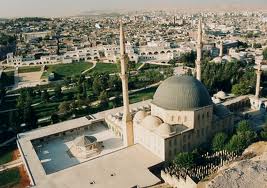
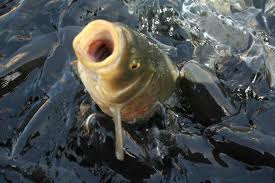
During our small shopping excursion, I’d picked up some elastic hair bands that I needed and watched as three pairs of hands reach into theirpockets to pay for them. Oooooo I like shopping here. I wonder if it works in shoe shops? A few minutes’ walk and we reach the cave of Abraham. Legend has it that the Babylonian King, Nemrud, had Abraham captured and thrown into fire. His crime? Calling upon the people to worship the real god and not the icons of celestial objects, as was the religion of the time. Of course, God was watching and on seeing this, he turned the fire into water, saving Abraham from certain death. Not content with that, he then turned the surrounding woods into the sacred fish, the ancestors of which we see today at the site of the “Halil ur Rahmen” Mosque in the centre of Urfa.
I buy a dish of fish pellets and watch the fat feisty fish fight each other for each tiny morsel, after which we take a rest in the cay bachesi. I sit sipping hot sweet tea and take a look at my photos so far. The photos are amazing; sneaky zoom shots of men at prayer and performing the abtest, plus the usual tourist shots of minarets and domes. It’s getting late now and as dusk settles over the city, we head back to the hotel.
Nemrud
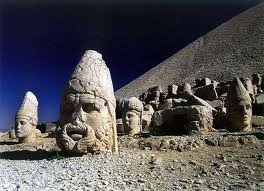
So far so good, my first day in Urfa was wonderful and I am hungry for more. We have decided to use Urfa as a base for a few road trips. On my list are: Harran, Nemrut, and Hasenkeyf, then, a stop at Cappadocia on the way home. I had no idea at the time but this journey would also encompass, Mardin, Midyat, Batman & Siirt. My Anatolian adventure continues.
Today’s post is hot off the press from Kirazli Karyn at Being Koy, veteran jobbing blogger and top drawer freelance writer. When I say veteran I mean prolific not aged. Karyn is a mere slip of a girl. She normally writes passionately and evocatively about her Turkish village idyll. It’s all true. We’ve seen it with our own eyes. Today she vents her spleen at the travel guide industry.
Karyn
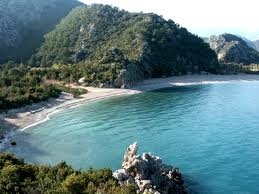
One of my friends visited Cirali recently, I suggested it, I thought he would find the ruins slowly collapsing into the forest beautiful, the tree houses were his sort of thing and as far as I was concerned seeing the flames of the Cimera on Mount Olympos was one of those big “things to see in Turkey”. Turns out I was right, he loved it; he loved the whole hippy vibe, sitting around a campfire jamming on a battered guitar, swimming in the dramatic coves and camping in the trees by the side of a dirt road to the beach. It was indeed, just his thing, but he got a bit nervous on the way there.
Cirali
On the bus from Konya to Goreme to explore Cappadocia before heading down to the coast he hooked up with some Japanese travellers, none of whom were going on to Cirali, in fact they’d never heard of it. It turns out this is because it wasn’t in their guide books and if it isn’t in the guide book, specifically in your demographically tailored, distinctively marketed guidebook, it doesn’t exist.
Some locations that used to be popular have disappeared from the guidebooks altogether despite the fact that they are beautiful and interesting and unique and others have appeared for no better reason than they are considered “off the beaten track” by some gung ho backpacking writer who has cottoned on to the fact that being a reviewer for some obscure guidebook is a glamorous sounding job and gets you laid more often than pretending to be a BA pilot and part time dolphin trainer. This makes up for being paid a pittance to go to shit places and eat rubbish food and pretend they’re great.
Where am I?
These days there are guidebooks for everywhere and every type of travel and traveller and if these were not enough now the guidebooks are supplemented by websites and forums and even apps for your phone, so the brave voyager need never again make an uninformed decision during the whole of their adventurous trek – that’s really character building. Places once considered off the beaten track are now, as a result, definitely middle of the well trodden road. If Leonardo de Caprio now jumped off that waterfall to find The Beach he’d have to push aside 200 tourists tweeting about their experience on their iPhones before he could surge into the water in a sexy and manly way.
This year my little village Kirazli made it into Lonely Planet, it gets mentioned as worth a visit, and the little paragraph about it bigs up a restaurant that is at best, mediocre. It used to be good, five years ago, it is now ok. I can think of three other restaurants in the village that are better and cheaper and have nicer staff. So basically this village gets mentioned for something it isn’t very good at and all the things it is really good at don’t get mentioned at all. This is typical of guide books really and is why they should be treated as a jumping off point for your journey, not a step by step instruction manual. Sometimes they’re wrong and sometimes you just need to turn off your iPhone, talk to a real person on the same road as you or take an unplanned turning, because getting off the beaten track is actually a state of mind not a place you struggle to and you can do it with a single step or a single conversation, you can’t do it with a multi million selling guidebook, that’s a contradiction in terms.
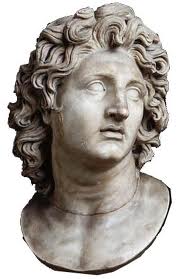
Turks are impatient motorists. Their ambling deportment on foot is transformed into Formula 1 wannabes as soon they get behind the wheel. Sometimes the narrow lane in front of our house is grid locked. This might be because a delivery truck is blocking the road by doing what delivery trucks do or simply due to the sheer volume of traffic trying to cut across town on market days. Crazy moped drivers weave dangerously through the static traffic and overheating drivers play the horn chorus. We watch the melee from the safety of our balcony. It can be quirky and comical, boisterous and baffling but rarely bothersome. However, we have witnessed two memorable hot-headed conflagrations, the first aided by a baseball bat and the second resulting in a violent push, a blow to the head and a few minutes on the ground unconscious. Still, I suppose it’s small beer compared to an average Saturday night in Croydon Centrum. To think that Alexander the Great, the most famous of ancient queens, marched along this very thoroughfare to claim old Halicarnassus (Bodrum that was) as his own before beating up the Persians and conquering half the known world. Get the madam!
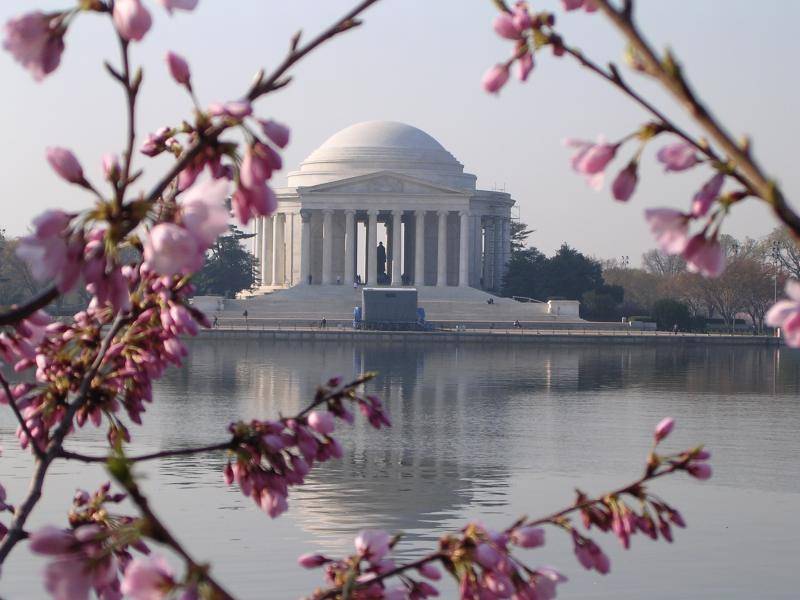
A Pansy flasher in Washington DC brought back happy memories of journeys across the pond. Over dinner I led Liam on a jolly romp down memory lane. He kindly indulged my remembrance. I’ve been to the States four times – to New York, Boston, LA and my first visit was to the District of Columbia at the tender age of 20. I had dallied with a travelling Yank who worked for the Federal Government and was attending a conference in London. He invited me to stay so I did. I had tired of my dull, dead end job as chief cashier and pound counter for Habitat in Chelsea and had in mind to do as millions of others had done before me and seek my fortune in the land of opportunity. I saved my pennies, quit my job, booked a one way ticket on Freddy Laker’s Skytrain to New York and off I went. I flew out of the Big Apple and down to DC.
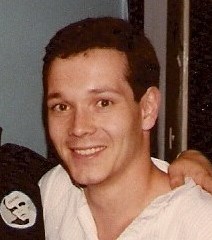
Me, yes really
My Yank got a shock when I called. It seemed his invitation hadn’t been entirely genuine but he was good enough to let me stay for a few weeks in return for occasional sexual favours. Springtime in Washington is very agreeable and a riot of cherry blossom. The federal heart of the city is laid out in imperial style and built in monumental neo-classical majesty as befits the capital of the most powerful nation in history. The grand design is best appreciated from the top of the Monument, the world’s tallest true obelisk. Rameses the Great must have turned in his tomb. I did the obligatory tour of the White House and the Capitol and strolled along the Mall popping in and out of the various museums along the way. It struck me how everything was described in the definite article – The White House, The Monument, The Capitol as if no others exist. It’s a sign of a confident young nation with a touch of teenage arrogance.
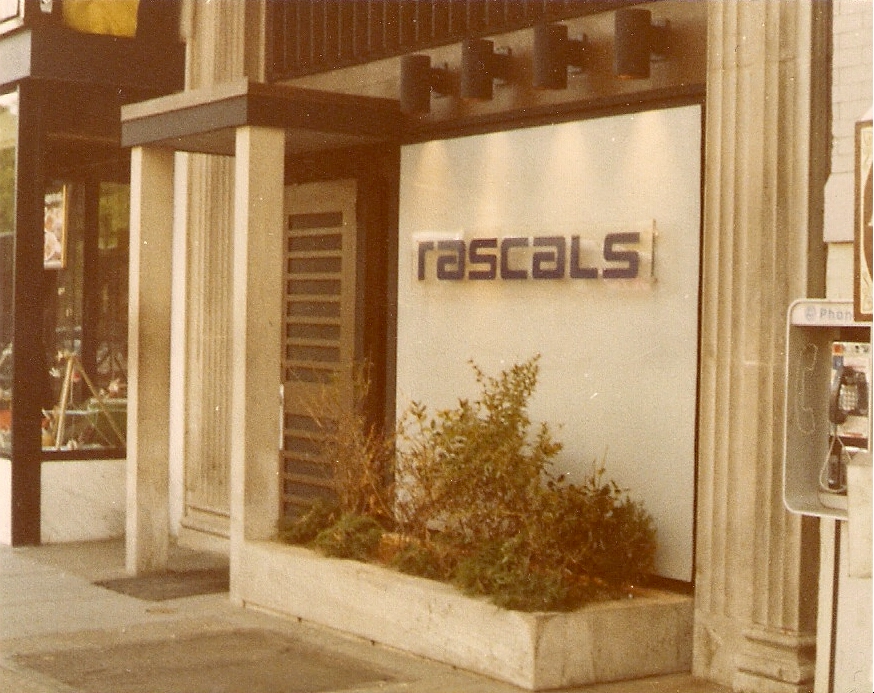
Gay life in Washington was a world away from recession-ravaged buttoned up Britain with its grubby backstreet gay bars. It’s taken London 30 years to catch up. I loved it and it loved me. I was young and handsome with cheekbones that could slice cheese. My hosts lapped me up and I let them. I wowed the randy scamps in Rascals, a popular watering hole and pick up joint for federal employees near Dupont Circle. They just loved my accent, along with my uncut assets.
Is it still there I wonder?
Alas, I sensed I was overstaying my welcome and my reluctant landlord feared I would claim squatters rights. My low-key patriotism also annoyed him. He rather expected me to be enamoured with all things American. I really liked what I saw but I had learned patriotism from my soldier father’s knee and have never been able to shake it off. After a few weeks living the American dream I pined for the old country and flew home on BA.
To this day I remain quietly patriotic, though not nationalistic. To be proud of where you are from is fine but to think you’re a cut above is not. This is a message some emigreys hereabouts would do well to hear. I wonder though, if I had settled Stateside, what would have become of me?
Bodrum is getting busier by the day as the town warms up with the weather. Works continues apace to complete the classy new streetscape before the summer rush. Contrary to my initial cynicism, a spacious new civic square is being laid out along the bar street rat run revealing a spectacular view of the crusader castle. It will be a place of sanctuary from the relentless hassle to come from the imported hawkers with their spring-loaded libidos. Whole villages in the East are being drained of their young men as they start their annual migration in search of casual employment and easy lays. We have a bird’s eye view of the caravan of young totty as they scamper past the house dragging their humble belongings behind them. The testosterone is palpable.









 Bodrum is getting busier by the day as the town warms up with the weather. Works continues apace to complete the classy new streetscape before the summer rush. Contrary to my initial
  Perking the Pansies