The Witching Hour

The Witching Hour

Of late, boozy gigs with ancient comrades from old London Town have been as rare as ginger imams. Somehow life just gets in the way. So, one evening I fired off a text.

“Boys. It’s high time we had a coven.”

After a flurry of replies, it was game on.

I always get down to the big city a tad early – to imbibe the vibe and cast my spell over the Soho boys. I know, hopelessly deluded. Gay scene wise, Soho isn’t quite what it was. Online ‘dating’ has seen to that. Nevertheless, a few old haunts stumble on, attracting the after-school crowd. I wandered into the Duke of Wellington (or the Welly as it’s affectionately known, my spiritual home back in the day). As I headed for the bar, I spied a former squeeze in the corner of my eye. By the time I’d been served, the hairy old crow had taken flight, leaving half his pint behind. Clearly, my magic wand has lost its vigour. I wouldn’t mind but it’s over twenty years since we stepped out.

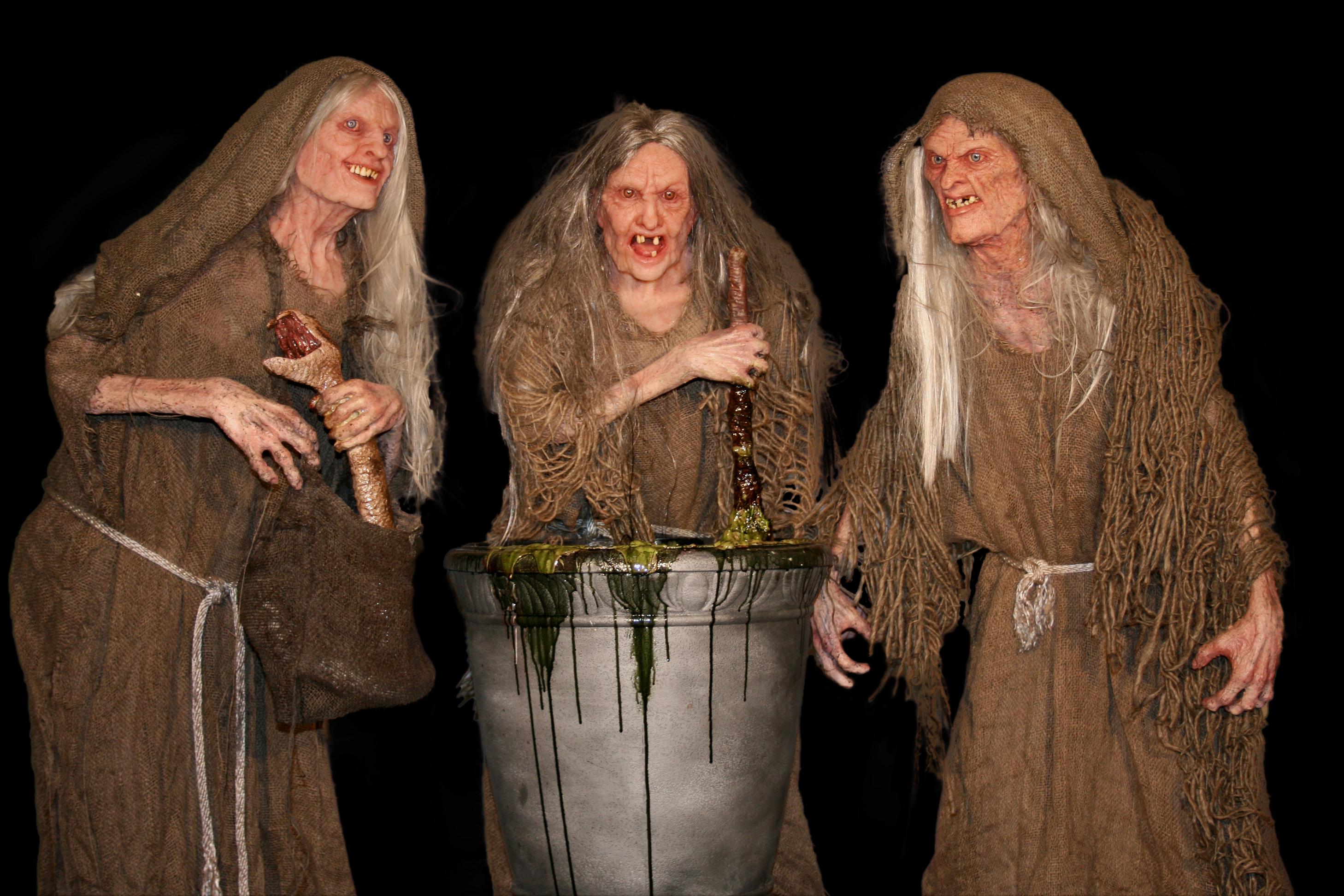
After a sherry or two with my London witches, we pitched up at a local brasserie for a bite and a long natter. We wittered on for hours about everything and nothing and by the time we were hoarse, the staff were sweeping up and stacking chairs around us. It was time to mount our broomsticks, and as befits three old sorcerers whose powers to bewitch have all but withered, we were tucked up in our beds by the stroke of midnight.

This is what we looked like twenty years ago before our allure had faded. Obviously, that’s not yer actual Taj Mahal. We were in Blackpool for a dirty weekend. And where better?
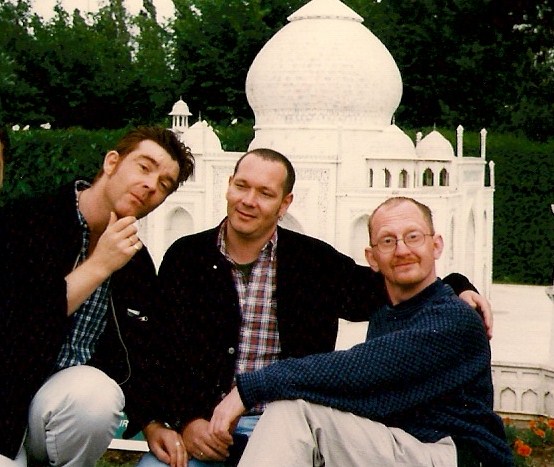
And this is what we look like now. No wonder our wands have dropped off.
May the Fourth Be With You

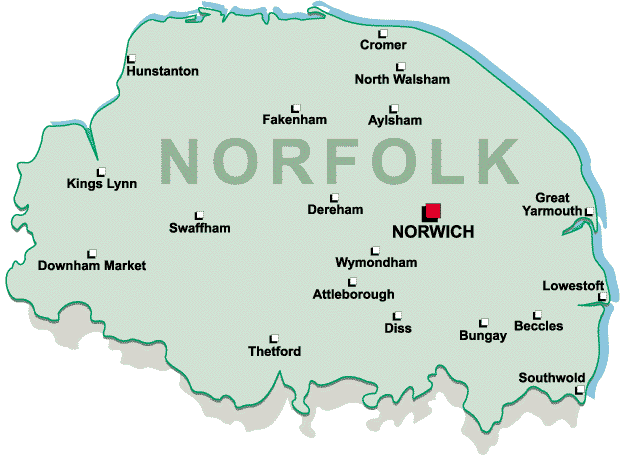
The fourth of May was local election day hereabouts. As in many rural areas, the people of Norfolk are conservative with a small ‘c’, distrustful of change and suspicious of (and sometimes hostile to) strangers. That’s why some farming folk keep it in the family and one or two get way too close to their livestock. It’s called Normal for Norfolk. Unsurprisingly, as a rainbow city marooned in a sea of blue, Norwich itself voted for a weave of red threaded with yellow. Norwich isn’t Norfolk, just like Bodrum isn’t Turkey. Apart from the liberal retirees of North Norfolk, the rest of our green and insular county voted Tory. The only crumb of comfort was the damn good thrashing meted out to the right-wing UK Independence Party which, right across the realm, lost all but one of their seats. After all, as Britain heads for Brexit high on the illusion of sovereignty, what’s the point of UKIP anyway?

Next month’s the big one – a general election – where the great British public give their verdict on the road ahead. I’ve always (foolishly) lived in the hope that common sense prevails in the end. But then I picked up the Metro, a free newspaper no better than a celebrity comic but distracting enough to read on the bus. It featured an article called ‘The Baffled of Britain’, a survey listing the things that most confuse the average citizen. Some get me scratching my head too, such as:

The offside rule in soccer

Getting out of IKEA

What women see in Benedict Cumberbatch

How Trump is president of the USA

But way up there at number 3 was…

Brexit

Gawd help us all.

Avenues and Alleyways

Avenues and Alleyways

We were in London for cake and fancies to celebrate my Mother’s 88th birthday. The old girl was in fine fettle – fag in one hand, brandy and coke in the other. I was going to post a video of her blowing out the candles to Happy Birthday, but with the lights off, it came out like a scene from The Blair Witch Project (the cult horror film not the dodgy dossier that did it for a former prime minister).

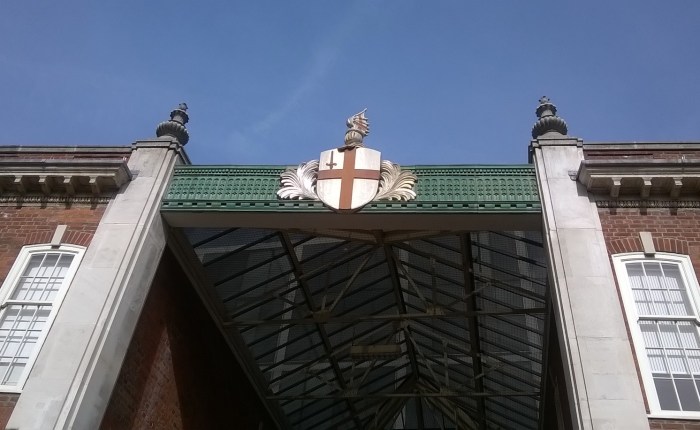
On our way home the next day, we had a couple of hours to waste before catching the train back to old Norwich so we took a wander round Spitalfields and Broadgate in the City. Last time we were there, we were richly entertained by Tangoing couples. No such luck this time, more’s the pity. So instead, I’m posting a few random shots from our meander. As with much of London, the area is a mishmash of styles old and new, tall and short. It’s what makes the City what it is and I rather like it.

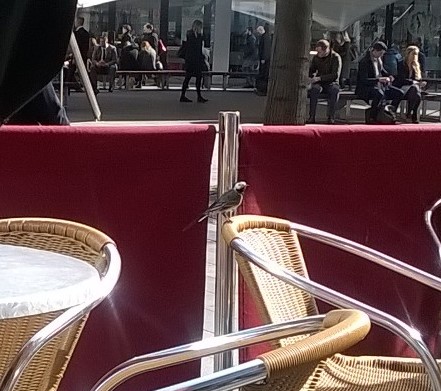
While supping coffee in the afternoon sunshine, Liam spotted a tiny bird nearby begging for a tasty titbit. Pigeons are commonplace in London but this little birdie was a pied wagtail, or so Liam told me. Liam is hardly well-acquainted with birds, so I had my doubts.

Pied Wagtail

Back to Liverpool Street Station in time for our train, we stumbled across one of the Kindertransport memorials which commemorate the rescue of around 10,000 mostly Jewish children from Nazi persecution just before the outbreak of World War II. It was an age when Britain and others were a little less shoddy to refugees.

Für Das Kind by Flor Kent

There’s a much grander statue on Hope Square in front of the main entrance to the station. But I like this one better as it seems to merge with the ebb and flow of the crowd. There are similar memorials in Berlin, Prague, Vienna and Gdansk. ‘Lest we forget,’ as the saying goes. Trouble is, I think we already have.

That Sinking Feeling

That Sinking Feeling

Norwich is riddled with old tunnels. Chalk and flint was mined for centuries, and many of the oldest mines run close to the centre of the city. Chalk was used for liming and mortar, and flint was used as a building material. You see flint everywhere – in what’s left of the old city walls, in the medieval Guildhall and in the 17th century weaver’s cottage we rented when we first paddled up the Wensum five years back.

Weaver's Cottage

Who knows what snakes beneath our feet? Many of the older shafts are uncharted, and sink holes appear without warning. Such was the case recently when a hole opened up close to the entrance to the Plantation Garden, Norwich’s sunken Eden, itself created from an old chalk pit. Babes in buggies and picnicking pensioners dropping into the abyss wouldn’t be good for business so the gardens were closed to the public while council surveyors did what council surveyors do. The hi-vis boys poked about a bit with their equipment and declared the area safe(ish). The gardens have now reopened and, once again, we can all look forward to a balmy summer of cream buns and string quartets.

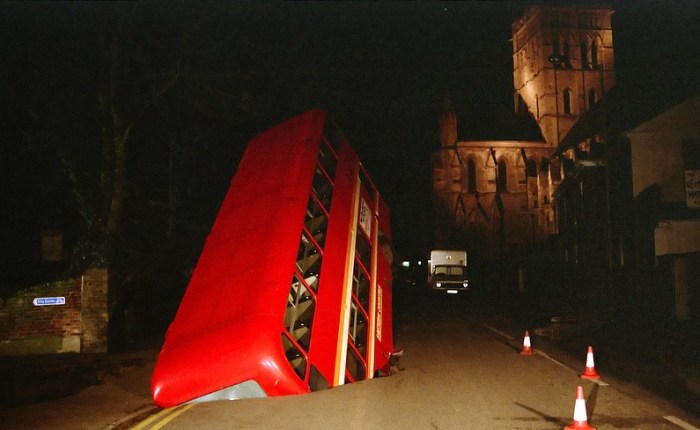
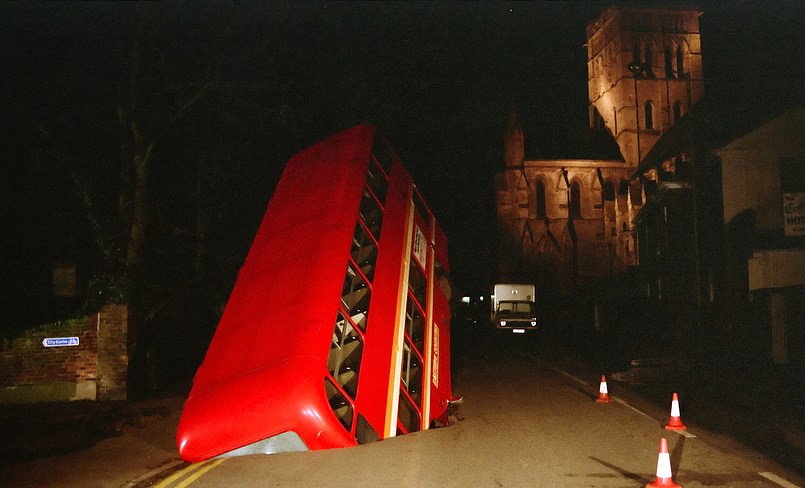
A more famous example of that sinking feeling happened in 1988 when the ground collapsed beneath a bus along the Earlham Road, close to the gardens. Shaken but not stirred, neither the bus driver nor his startled charges were hurt. Pictures of the scene were beamed around the world; sleepy Norfolk gained international notoriety not seen since 61AD when Boudicca gave the Romans a bloody nose and razed Londinium to the ground in the first great fire of London. The whole area around the gardens is a death trap. The papal faithful at the nearby Catholic cathedral best get down on their knees to prevent the congregation going down like the Titanic.

Not to miss a trick, confectioner Cadbury, used the incident to promote one of their products with the line…

Nothing fills a hole like a double-decker.

I couldn’t agree more.

East Angrier

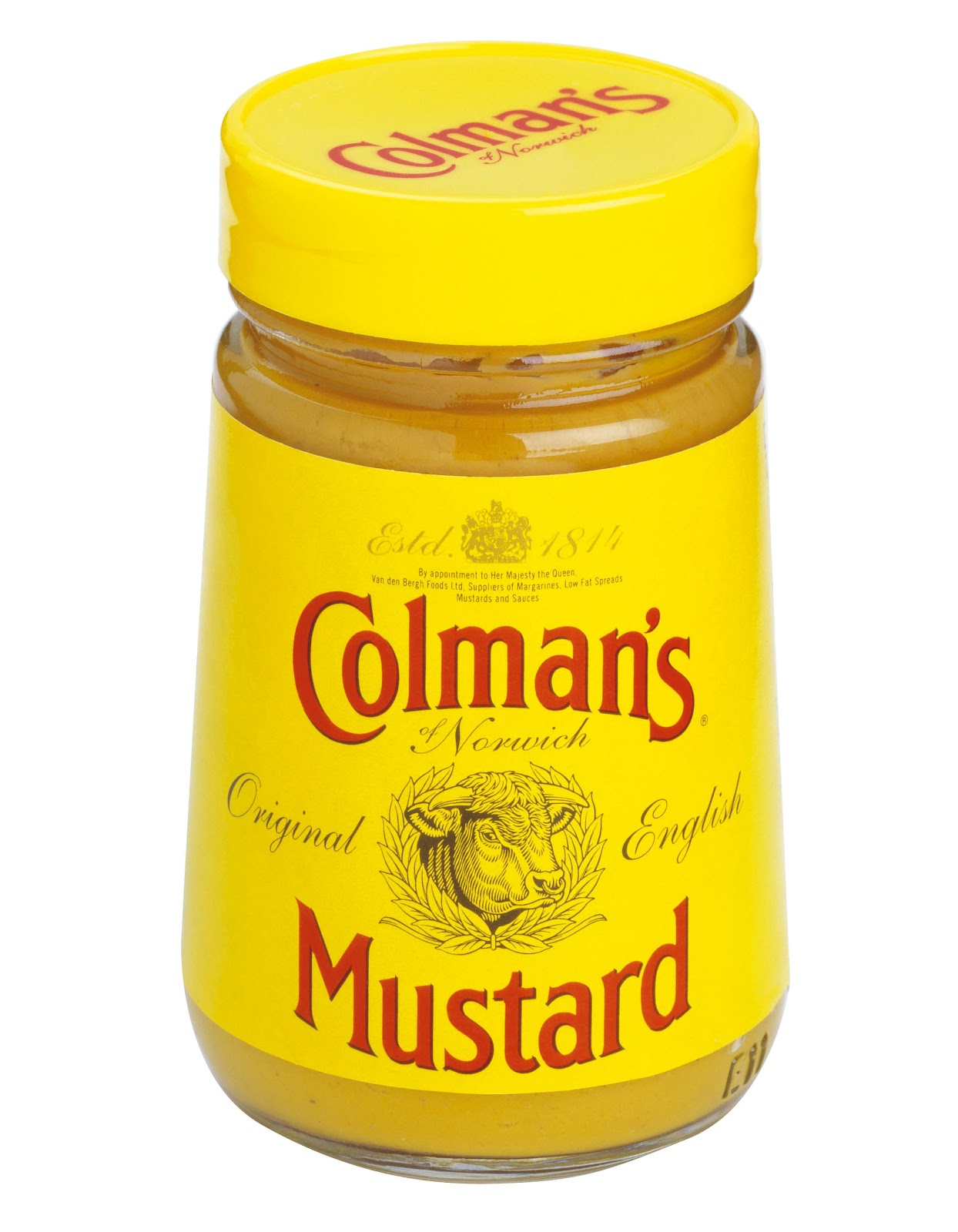
Norfolk has its very own community television station called Mustard TV. Why Mustard? It’s a nod to Coleman’s mustard, the city’s famous hot and spicy condiment. The station is run on a wing and a prayer, and presented by those at the very start of their broadcasting careers and others at the very end. With Liam on family duties in London and me with thumbs a-twiddling, I channel-hopped onto Mustard and stumbled on ‘East Angrier’, a vox pop show for local yokels to vent their spleens. Here we go, I thought, another rant by the ignorati spitting out their fake views. But, no, I was pleasantly amused. No bigoted salvos about Johnny foreigners, Islam or Brexit. A few fine citizens had a go at Trump (that works for me) and annoying self-service tills in supermarkets (that works for me too). One Norfolk broad whinged about the number of spam emails she gets (tell me about it) and a grumpy old git reflected on the appearance of his fellow Angles…

Blokes over 30 wearing skinny jeans with the knees cut out look like bleep, bleep.

And…

Bald blokes with ponytails. What the bleep is that all about?

Clearly a man after my own heart.

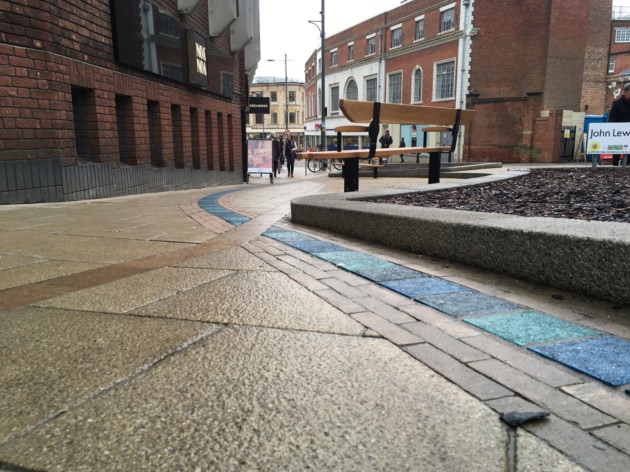
And then there was the scruffy student fretting he hadn’t finished his essay on David Hockney. He was standing astride the line of blue and green glass tiles which flows down Westlegate marking the course of one of Norwich’s lost rivers – the Great Cockey. This is not to be confused with the Little Cockey which isn’t worth parting your legs for.

I Beg Your Pardon

alan-turing

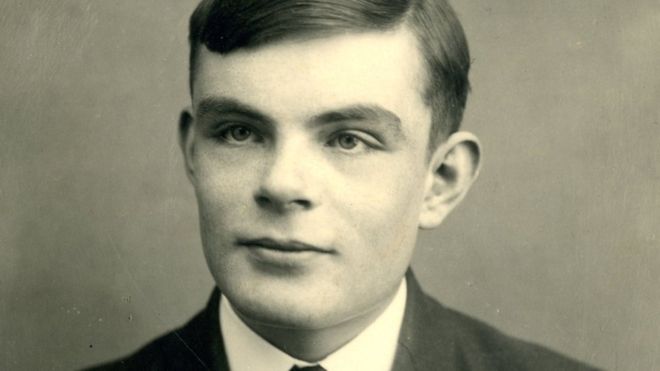
All men convicted of homosexual offences no longer illegal have now received a royal pardon. The general pardon (so-called Turing’s Law) is modelled on the 2013 pardon granted to Alan Turing, the mathematical genius who broke the German Enigma codes during World War Two and shortened the war, saving thousands. In return, he was convicted by an ungrateful nation of gross indecency, chose chemical castration over incarceration and killed himself in 1954 at the age of 41. It’s a story full of shame, none of which was his. For the dead, the pardon is posthumous. Those still alive and mincing (reckoned to be around 15,000) can apply to have their convictions expunged from the record. I could have been one of them. I just didn’t get caught.

The Time of Their Lives

The Time of Their Lives

Billed as the road movie for the silver generation, ‘The Time of Their Lives’ stars Collins’ Joan and Pauline supported by ex-Italian stallion, Franco Nero. Clapped-out former screen goddess, Helen (played by Joan – no typecasting there then), hearing about the death of an old squeeze from her glory days, escapes the knacker’s yard, determined to ham it up at the funeral in France. Along the way, she picks up dowdy and downtrodden housewife Priscilla (Pauline) and the grey fugitives race côte à côte in a stolen Renault Captur. Franco Nero is the old stud in a battered 2CV with the hots for Pauline. There’s a full-frontal scene where he jumps naked into a pool. Now I know what perked up Vanessa Redgrave all those years ago when she played Guinevere to his considerable Lancelot in Camelot.

‘The Time of Their Lives’ has shades of ‘Thelma and Louise’ and ‘Shirley Valentine’ about it but, sadly, it’s not a patch on either. A tighter script and better lines would have helped. For us, the funniest moment came when the Norfolk broad in the row behind us dropped her gin – over her lap, over her seat and over her giggly companion. And with the best will in the world, Trump-loving ‘national treasure’, Joan, can’t match her fellow theatrical dames for pathos (or politics). Nevertheless, it was a charming excursion and diverting way to pass a Sunday afternoon.

Lion

Lion

Lion

I’ve always been a sentimental old fool. I only have to hear Vanessa Redgrave’s voice-over at the start of Call the Midwife and I start to well up, knowing the everyday trials and triumphs of East End childbearing during the fifties and sixties will leave me drained and limp. So I should have known better when we decided on a distracting afternoon at the flicks to watch Lion. Based on a true story, it’s a heart-churning tale of a five-year-old Indian boy who, by tragic happenstance, finds himself lost and alone on the mean streets of Kolkata, far, far away from the dusty plains of home. Following near misses with the truly unthinkable and a stint in a teeming orphanage, he’s plucked from the crowd by a well-meaning Australian couple and re-homed in comfortable Tasmania. Job done, lucky boy, you might say. But 25 years later, haunted by vivid flashbacks of his childhood, he sets out to find his long lost family in an attempt to calm his troubled mind. Lion speaks volumes, not just about the casual horror of life on the streets but also the cultural dislocation and guilt felt by those airlifted to affluence. Dev Patel is excellent as the man on a mission to rediscover his past. But the undisputed star of the show is the extraordinary Sunny Pawar as the lost child. Take a box of Kleenex. You’ll need it.

John Hurt, RIP

john-hurt

John Hurt, the first Chancellor of the Norwich University of the Arts, was a talented, versatile and prolific character actor. His superb portrayals of John Merrick, the Elephant Man, Max in Midnight Express and Caligula in the BBC’s I, Claudius immediately spring to mind. There are many, many others in a career spanning six decades. But for me, it was his role as Quentin Crisp in The Naked Civil Servant which resonated the most. It was 1975 and I was 15 and fretful. The film was a revelation. Not because I wanted to do a Crisp by slapping on, dragging up and renting myself out for a few shillings. No, because I suddenly realised that if Quentin could live an unabashed life during the most hostile of times, then my own coming out might not be so traumatic. Apparently, John Hurt was strongly advised against taking the part. It would be career suicide, he was told. Hurt ignored the doomsayers and I’m so glad he did. And despite a few initial wobbles, my step from the closet turned out just fine.

The Story of Norwich – Tinker, Tailor, Soldier, Sailor, Rich Man, Poor Man, Bomber Man, Thief

The Story of Norwich – Tinker, Tailor, Soldier, Sailor, Rich Man, Poor Man, Bomber Man, Thief

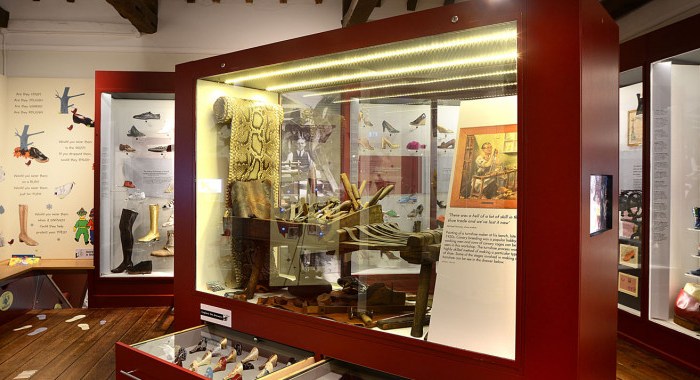
Our flat is like a weather chamber. When Mother Nature decides to throw a wobbly, we hear every eruption. So last month when Storm Doris (Doris?) huffed and puffed with 90 mph winds, we feared she’d blow the house down. We decided to abandon the microloft and seek refuge elsewhere. Usually this would be the pub but on this occasion we choose the Bridewell Museum. The Bridewell charts the civic and social history of Norwich – from its modest beginnings as a few Anglo-Saxon huts on the muddy banks of the river to the pillaging Vikings, conquering Normans, religious glory days of spires and steeples, economic salvation by Flemish refugees, a spectacular rise to become England’s second city, a slow industrial decline and the city’s renaissance as a financial centre, cultural hub and UNESCO City of Literature. It’s a ripping yarn of churches and chapels, friaries and priories, martyrs and merchants, weavers and cobblers, chocolatiers and mustard makers, fire and flood, black death and blitzkrieg. Norwich was the first British city to build social houses and the first to have them flattened by the Luftwaffe – two of the many things catching my attention as we meandered through the exhibits. And what fun we had dressing up.

If you’d like to know more, check out Norwich Museum at the Bridewell.

Afterwards we did make it to a local hostelry for a few jars. Well who am I to argue with the lady?

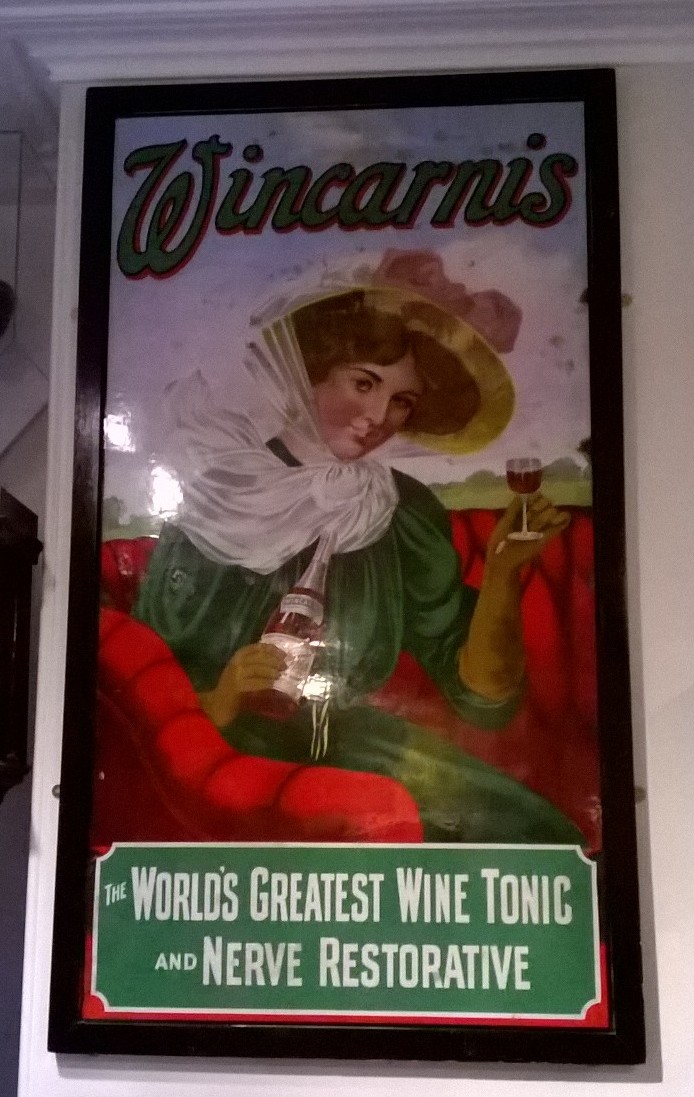
wincarnis-wine-tonic

And so we survived Doris’ rage in one piece. Which is more than I can say for the roof.