But What Are They Eating?

But What Are They Eating?

Author Shelley Workinger runs a blog that provides a unique approach to book promotion – food and the consumption thereof. My expanding waistline is evidence enough of my love of all things culinary, so I bit her hand off to get featured.

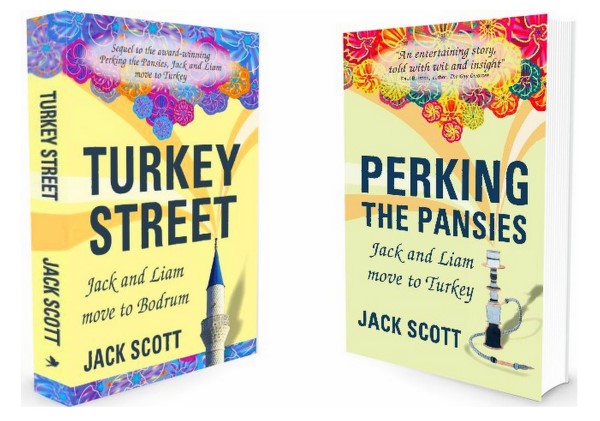
Turkish cuisine is justifiably famed as one of the world’s greatest. The Sultan’s table overflowed with extravagant bounty from the vast Ottoman domains that once stretched across three continents. The empire may be history, but food – preparing it, eating it, sharing it – is still of enormous cultural importance to all Turks regardless of status and income. So it’s small wonder the simple act of eating plays a starring role in both of my memoirs, Perking the Pansies and its sequel, Turkey Street. Here’s a soupçon…

More…

Learning Turkish

Learning Turkish

I get regular requests from people asking to guest post here at Pansy HQ.  Generally, I politely refuse because the subject matter just doesn’t work for me – too commercial/ too dull/ too libellous/ too weird/ totally irrevelant (delete accordingly). Occasionally, though, something falls on the mat that rings my bell.  This is such a post. Why? Because it’s from someone who’s written a fascinating memoir about Turkey and the post is about the agony of learning Turkish. I failed pathetically to grasp even the barebones of the language. Liam fared much better.  So, ladies and gents,  please give it up for talented bilingual Yankee author, Ann Marie Mershon.

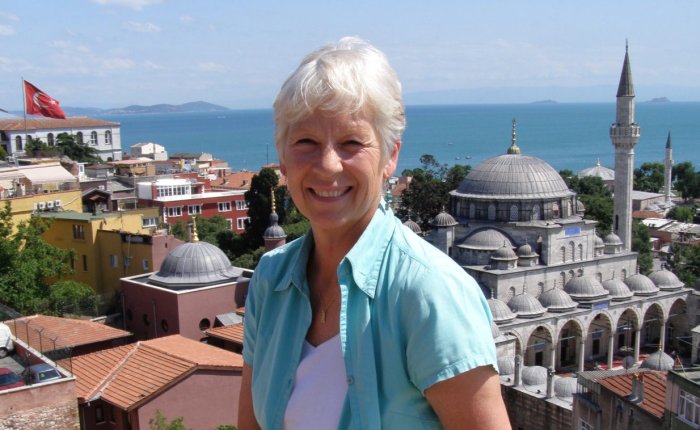
Who would have thought I’d live in Turkey? It evoked an image of mustachioed Bedouins galumphing out of the desert on camels—and I could barely find it on a map.

No, thank you.

An American teacher, I yearned for adventure, an escape from a world that was imploding on me. A painful divorce had left me on the perimeter of social gatherings, keenly aware of my image as a divorcee. Not really a pariah, I felt like one.

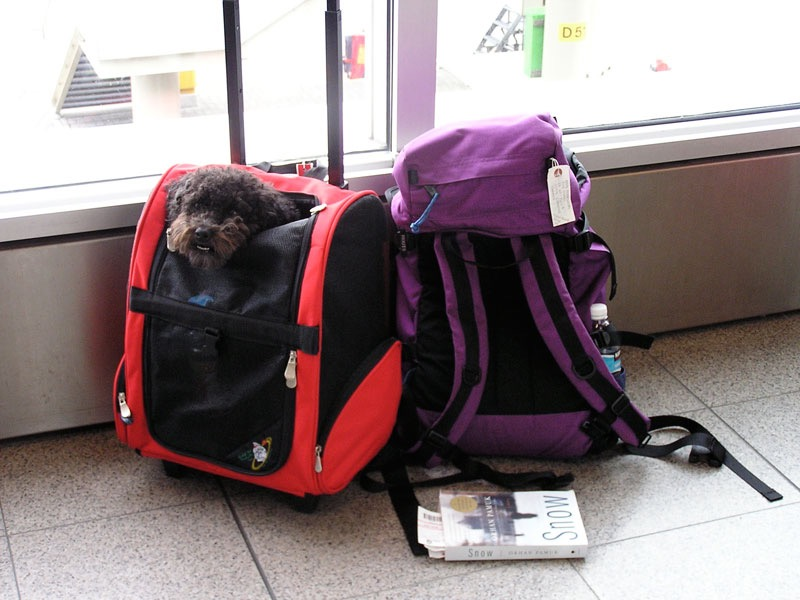
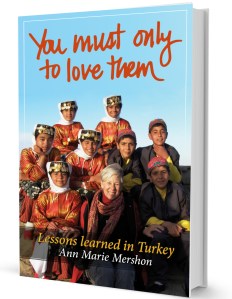
Ann Marie's DogThis excerpt comes from the preface of  You must only to love them, lessons learned in Turkey, which recounts my trials and joys adapting to life in Istanbul. Smarting from a recent divorce, I had decided to establish a new life overseas, intending to find a teaching job in Paris or Salzburg. Through a number of possibly serendipitous events, I landed in Istanbul instead (with my little dog). So began my love affair with Turkey and the Turks.

Actually, it wasn’t a love affair right off, as I battled loneliness and the frustrations of language as I navigated my new world. It was probably to my disadvantage that I lived on the remote and very English-speaking campus of Koç Lisesi (20 miles east of Central Istanbul), but the school kindly offered free Turkish lessons for foreign hires and there were a number of Turkish administrators living on campus. They also offered service busses to get us into the city on the weekends. which was a godsend.

I’d prepared for my move by purchasing and diligently studying a book called Teach Yourself Turkish. Each new lesson brought more questions than insights, but I forged on, thinking I’d learned the basics before moving to Istanbul. At least I knew tuvalet (toilet), bira (beer), and şarap (wine). What more could one need? Well, anlamadım came in handy (I don’t understand).

I thought I’d learned numbers, but once I tried to buy something in Istanbul I realized that Turks talked REALLY fast. Gosh, what was that word that meant slowly’? My first forays from campus into the Turkish world were riddled with anlamadims and yavaşes.  I guess that’s typical.

Turkish class on Wednesdays after school was helpful, but I needed more conversation and less grammar. My GOODNESS, the grammar was overwhelming. I wished that our charming teacher had first explained the basics of Turkish. Here’s what I think they are:

  • Every sentence begins with a subject and ends with a verb with all the modifiers in between.
  • Most languages have six possible verb endings (first person singular and plural, second person singular, etc.), while Turkish multiplies that by four. They like to vary those six endings with four variants order to harmonize with the verb. Twenty-four basic verb endings. ARAUGHHH!!!
  • There are a few letters that are confusing but you get used to them: c sounds like j, and ç sounds like ch, ş sounds like sh and the only silent letter is ğ, which is sort of a placeholder in a sentence.
  • The beautiful thing about Turkish is that every letter ALWAYS makes the same sound – hence, no need for spelling bees in elementary school. If you can say it, you can spell it.

You must only love themIt took me years to learn more than the rudiments of Turkish, and I’ve come to an amazing realization. The best way to learn a language is to immerse yourself in it. When I finally lived off-campus in a sweet apartment up the hill in Arnavutköy, I began to truly learn Turkish. I had no choice if I wanted to survive, as few people in my little community spoke English. I chatted with the checkout person at DIA, I sat talking with the electrician as he fixed my hair dryer, and I met a boat captain who often invited me for a cup of tea on his back deck. It was a delight. The Turks helped me learn their language, just as they help us whenever we’re in need. It’s just who they are.

You must only to love them is available through Amazon.

About Ann Marie

Ann Marie Mershon

Ann Marie Mershon is a Minnesota writer who taught high school students in Istanbul between 2005 and 2011. She kept a weekly blog while she lived there. She also published a guidebook with Edda Weissenbacher, Istanbuls Bazaar Quarter, Backstreet Walking Tours. She now lives on a lake near the Canadian border with her husband and their two dogs. Visit Ann Marie’s website at annmariemershon.com.

Fancy a free print copy of You must only to love them? Enter the Goodreads giveaway here (May 1-May 16 – US residents only). Or for a free e-book, enter here (May 10-17).

Turkey in Berlin

Today, I’m featuring a guest post from the gorgeous Marta López, a Spanish travel writer based in London. I rarely include guests posts on Perking the Pansies these days (and never for profit) but when Marta asked if I’d like to publish her article on the trendy Kreuzberg district of Berlin, serving up one of the coolest cities on the planet with an authentic Turkish twist, how could I refuse?

So ladies and gents, I give you…

Turkey in Berlin, Five Reasons to Visit Kreuzberg by Marta López

The German capital hides lots of history and monuments that you definitely should explore when visiting the city for the first time. Once you have done all those things mentioned in your travel guide, there’s still a stop for you at one of the coolest and more colourful districts in Berlin: The Kreuzberg or as it’s also called “the Turkish Berlin”; a very trendy quarter that houses the most alternative culture in the city. This is the home of anarchists, bohemian souls and of course the large Turkish community in Berlin.

These are my top 5 reasons to visit this district in the German capital. And remember, Kreuzberg feels neither East nor West!

1.      It’ s a very multicultural area

It used to be the black sheep of West Berlin (a sort of Bronx in Berlin) and now the truth is that it is the area with the most personality in town. 40 % of the population here is Turkish and the rest of the neighbours are immigrants, especially in the side known as “SO 36”. Every year there is a big festival called “The Carnival of Cultures”, a four day urban festival that reflects the quarter of different faces and cultures. Next year the celebration will take place on the 4th June. Do you fancy a bit of multicultural atmosphere?

2.      You’ll find the best kebabs ever!

Kreuzberg is far from picture pretty and perfect but it´s really cool! Thanks to its large Turkish community living in the area, when you visit the district you will find an endless list of local Turkish bars where you can taste authentic and spicy kebabs. Top tip: Pop in at Imren Grill (Boppstr 10, Berlin) and try their tasty and juicy meat! Did you know that the Donner Kebab was actually invented here? The inventor was a Turkish expat called Kadir Nurman who has just died last October in Berlin.

3.      It’s full of exotic markets

There are lots of colourful markets surrounding the district. Visiting the Turkish market in Maybachufer (note that the market closes on Mondays) means literally transporting yourself to the beautiful Mediterranean country. Here you’ll find exotic textiles, different kind of hummus and lots and lots of people searching for the best products at the best price. Top tip: Try the Turkish pizza; it is out of this world!

4.      You’ll find an alternative culture

It is the home to Berlin’s punk rock movement, as well as other alternative subcultures. From graffiti covered lanes to random museums and galleries like The Berlinische Galerie, which contains Berlin art dating from 1870. But it’s not all about underground art. The Kreuzberg district is also the Mecca for fashionistas! Here arrive all the up-and- coming designers, so if you fancy unique accessories, don’ t hesitate to visit High-Lite (Bergmannstraße 99, Berlin) -We could say it´s a bit like any Shoreditch store in London.

5.      Best nightlife atmosphere in the city

Who said that in Germany it’s not possible to go out until 6.00 am? In Kreuzberg the nightlife starts late and seems to end early in the morning! Most of bars here have that bohemian charm that will encourage you to stay for hours. Don’t miss out clubs such as Lido (Cuvrystraße 7, Berlin) which is in an old cinema from the fifties and runs parties on the weekend, or Monarch Club (Skalitzer Straße 134, Berlin) based in a building that offers amazing views and the best electronic music. If you are a young clubbing addicted adult, you can’t miss it!

Getting there

Transport

Berlin-Tegel Airport (TXL) is located only 8 km from the centre of the city so reaching the centre will take you around 20 minutes. The city buses are the best option. They stop at different points through the city; the main stop in the centre is Alexanderplatz, located in the heart of the Mitte area. If you need to travel from Berlín-Schönefel Airport (SXF) to the centre of Berlin, you can choose between three options: The regional train, the B-Bahn train and the bus that runs on a regular service.

Where to stay

If you are looking for accommodation and you want to stay closer to the alternative scene, you can search hotels in Berlin near Kreuzberg with Expedia. Remember this is probably the most budget-friendly side of the city!

Author Bio:

MartaMarta López is a travel writer based in London.  She loves travelling and discovering new cultures. When she isn’t writing on her laptop, she can be found around the city looking for the coolest urban art. Follow her adventures on twitter @Martazepol

The Spirit of the Games

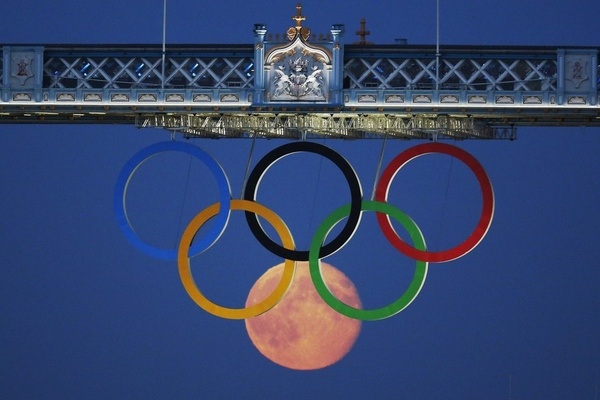
As the sun sets on the Friendly Games (bring on the Paralympics), I bring you an accidental guest post from an ancient friend and co-host of the Olympic Opening Ceremony knees-up we attended. It’s accidental because it’s actually an email he sent to the good, the gobby and the inebriated who graced the penthouse pad party and emptied his wine cellar.

Hit it Ian…

Following on from the AMAZING opening, this last week just seems to have transformed London from the mildly aggressive and pushy city we all know and usually love, into something rather special. Just wanted to share some of my ‘all warm inside’ moments of this historic week.

One was my fairly usual 9am-ish District Line ride to work. Alongside the 2012 tracksuit wearing larger men and womenfolk who look like they could only win Gold in a pasty eating competition, 2 Austrian Olympians joined the carriage at Mile End in their matching white tracksuits complete with Austrian team logo and dangling Olympic passes. A young lad in his twenties and an older (well mid-thirties) tall guy with cropped hair (very Teutonic). As I glanced up from my Metro (could that paper be any duller?) the young lad had his arm around cropped hair and when they looked into each others eyes, they had that look that only people in the honeymoon period of a relationship have –  a mix of lust, anticipation & hope. Of course no-one batted an eyelid in the carriage, and it was as normal as delays on the Central line..I bet they didn’t do that in Beijing.

Another transport trip earlier in the week saw us sharing a Docklands train with a mass of nationalities returning from the Greenwich Park Eventing. a middle aged Irish guy was using the blarney on some loud and tipsy New Zealand wenches and telling them that Ireland’s 5th place result was the best ever and to celebrate he’d been asked to a drinks reception at the Irish Embassy. Now that’s how to impress tipsy Antipodeans.

Then the most heart warming happening of all followed on the next day. A morning trip to Boots in Piccadilly Circus on the way to work to get some essentials (no, not those…). As I was perusing the men’s toiletries aisle a smart young lad with suit and badge asked me if I would like some help and then not only took me to the item on the shelf, he picked it for me and offered it in said basket all with some witty banter and winning smiles. He signed off by wishing me a nice day. I was momentarily stunned.  Normally you could have collapsed in the feminine hygiene aisle in this Boots and been walked over for ten minutes before Security’s arrival to remove you. I almost skipped to work.

Add on to the above the smiling and funny volunteers who guided me through security at the North Greenwich Arena (02 to us) within ten minutes from tube to seat, the mix on the streets and shops of Olympics bods, fans and tourists, the genuine (and noisy) fans filling all the fantastic stadia even at 10am in the morning..and the fact I seem to be permanently glued to Claire Balding or Gabby Logan on the magnificent BBC (abuse it at your peril Jeremy *unt) and it all completes my warm glow for this beautiful city I call home.

Even the weather has been on our side.

Arise London for you are putting on a winning performance as I always believed you would, from the energy of the Olympic stadium, the noise of the Velodrome, the beauty of Hyde Park and the majesty of Greenwich. And you and your welcome are the true star of this 30th Olympiad so far.

Not like me to be effusive. Must be the warm glow (or the onset of senility). Back to Gary Lineker and Sue Barker’s helmet hair…

You might also like:

Let the Games Begin

Rainbow Sporting Heroes

Trailer Trash

When I planned my virtual tour, I knew the book would have to take centre stage. There would be little point if it didn’t. But I didn’t want to just bang on about it and do the hard sell. People would get bored and simply switch channels. I know I would. I had to find a theme, something to maintain interest. I also wanted to say something related to the people that have kindly let me loose on their blogs. A theme gradually emerged: me. My favourite subject.

Today’s post is on Helen’s European Journey. Elegant Helen is wander-lusting gypsy-like across Europe (well, so far across Iberia – give ‘em time) in a travelling caravan with hunky husband and two pretty pussies in tow. So, folks, I give you… me and caravans. Not the dusty camel trains of antiquity hauling exotic goods along the ancient Silk Road from China to Anatolia, but the common or garden static metal type of my childhood. It’s a tenuous link, but stay with me.

Over the Helen for Trailer Trash

M’Lady and the Crazy Marionettes

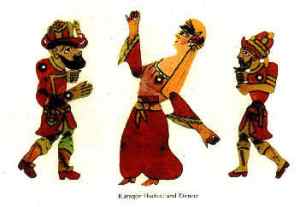
Next whistle stop on my virtual book tour (are you still on the train?) is Liz Cameron’s blog, Slowly-by-Slowly. Liz writes with depth and poetry about her cross-cultural life as an American married to a Turk through the eyes of a troupe of Ottoman era Karagöz shadow puppets. She’s not insane. It’s a metaphor, silly. Of greatest interest to me, though, is that Liz lives in Provincetown, a pretty little New England seaside resort which is a summer mecca for gay visitors – a kind of American Brighton. Yes, I am that shallow. My invite to ogle the shocking males must be lost in the post. The shocking mail in Turkey is to blame, no doubt.

Hop over to Slowly-by-Slowly to catch the book review and to hang out with M’Lady and the crazy marionettes.

.

Istanbul Stranger

I was really pleased when Istanbul Stranger asked me to guest on her blog as part of my virtual book tour. She’s deliciously witty, calls a spade a spade and her sharp observations about her life in Old Constantinople are a joy to read. She’s American but I think her writing style has a distinctive ironic British twist. Maybe she was a Brit in a former life. I’m there to plug my book but, as this isn’t Oprah’s Book Club, I thought I’d regale you with tales of my first visit to the good old US of A.

Ladies and Gents I give you Yankee Tales.

Gidday from Turkay

To my eternal shame, I’ve never been to Oz. Liam, has. He loved it and wanted to stay. Forever. He even considered re-training as a hairdresser to gain enough points to emigrate (crimpers were in short supply at the time, apparently). From civil servant to coiffeur would have made a dramatic career change. He thought better of it when he realised it was a gay cliché too far. That was before he met me, of course.

More at stop two on my virtual book tour. Hop over to Gidday from the UK.

Perking the Pansies Book Tour

For generations, book tours have been a vital part of promoting the published word. The famous get to hop from country to country. The not-so-famous get to hop from town to town. Nobodies like me don’t get to hop at all. Then someone came up with a marvellous idea – the virtual tour. No hopping involved. Just sit back and let other people promote your work courtesy of the blogosphere (in the best tradition of I scratch your back, you scratch mine). Ladies and gentlemen, please hop across to the wonderfully rustic Archers of Okçular for the first stop in my stimulating, simulated tour. Enjoy!

Perking the Pansies in Southwest Turkey

Jane Akatay is an experienced journalist of depth, intelligence and passion. Jane and I first met when she approached me to participate in an article she was writing about English Language bloggers in southwest Turkey for the Turkish Daily News. Jane’s article, The Tales that Wag the Blogs, cleverly inter-weaved the views of five different quality bloggers, each with their own unique perspective on expat life. When I neared completion of the book, Jane was the first person I turned to for a review. Despite her busy schedule, Jane was pleased to oblige and she wrote more than I could have hoped for. It’s not a brief throwaway review. It’s an in-depth, forensic critique set within the context of modern Turkey mores. It blew me away. Thank you, Jane.

___________________________________________________________________
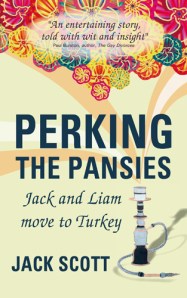
A decade into the 21st century along comes Jack Scott, a gay middle-aged man, who has bravely taken early retirement, daringly chosen to share his day-to-day experiences of life with thousands online in his blog, ‘Perking The Pansies’, and has now written a book with the same title.

No big deal, you may think; it’s been done already. So what? But this man, his blog and his book are more than a little different: Jack Scott lives in a predominantly Muslim country.

Not content to live in the accepting social scene of cosmopolitan London, he and his husband Liam have chosen to come and live in southwest Turkey, a decision that not only subjected them to scrutiny from the Turkish community but also to the watchful eyes of the burgeoning expat community, many of whom he describes with delicious vitriol and cutting humour. With the forthcoming publication of his book, Perking the Pansies, his lifestyle choices and intimate details of his everyday life will be open for inspection by the rest of the world.

Ask a cross-section of Turkish people, especially down here on the coast, and they will tell you that Gayness is a western problem (read ‘disease’) and doesn’t exist in Turkey. It is also generally accepted (as in so many other countries and institutions throughout the world) that the only homosexual in an active relationship between two men is the one who ‘receives’. The ‘giver’s’ behaviour is not deemed to be remarkable at all: after all they are just members of the notorious ‘any hole’s a goal’ club.

So how does a sexually repressed and quintessentially macho society relate to two men living together in marital harmony?

Ten years ago many ‘straight’ British men on holiday in Turkey expressed their shock when witnessing Turkish men’s tactile behaviour with each other: holding hands, casually draping their arms around their friends’ shoulders, resting a hand on a friend’s knee – and leaving it there.

Any physical contact between men, to most Brits, smacked of homoerotica and to their suspicious homophobic minds meant that these demonstrative men were either gay or, even worse, indiscriminate in their sexual preferences – after all even married men were seen to be doing it.

When a gay (and famous) ‘artist’ came along to a local restaurant popular with tourists at the end of the 1990s and, decked in veils and with his heavily kohled come-hither eyes, danced in the most superbly, sensual way imaginable (Turkish men, whatever their shape, age or sexual orientation are generally wonderful dancers), complaints from tourists of both genders: the decadence, indecency of it was evidently traumatising for the average Daily Mail reader and their children. Homophobia is by no means the sole preserve of conservative Brits.

Talk with any heterosexual, bi or gay western man who is open enough to speak about his gender identity and sufficiently emotionally intelligent and aware to question his own sexual vulnerability and he will often say that the rules of oriental societies are blurred to the point where they no longer know what the rules actually are even though they are sure they exist – yet Jack Scott made an active choice to leave the UK and come and live in such an inscrutable society with his partner, Liam.

Scott attempts an explanation: it was economically more viable for the couple to live in Turkey, having taken early retirement? ‘Bill’ the name given by Jack and Liam to their computerised accounting system would suggest that this is no longer the case. Times are hard for all expats living on the dwindling interest realised on their investments.

Sunshine and wonderful summers would seem another good reason perhaps, but as Scott illustrates the winters are cold, wet and frequently miserable and the summers are scorching. For people attempting to get on with their lives, rather than holidaying, the climate is not so kind.

Turkish society maybe provides an answer? It is certainly hospitable and charming on the outside. But as they discover following a murder, it has a dark homophobic underbelly, exacerbated by violent sexual acts (the man’s body reveals evidence of rape), and subsequently a few people warn the couple that views are hardening against gayitude. There is also the disadvantage of a cumbersome bureaucracy, slow, opaque and frustrating for those used to transparency.

No, it seems that, like so many other visitors to Turkey, these two men simply fell in love with the country and all that that entails. They sell up and move out but with a proviso that should the experiment fail they would return to the UK.

There again, many make that choice, for a variety of reasons, but all too often when the dream has turned into a nightmare they no longer have the wherewithal to return and are stuck, full of loathing. Scott pulls no punches when meeting such people and it is a warning to all to beware of becoming nothing more than negative whingers.

Scott’s crisp little portraits are of embittered British expats and Chrissie and Bernard are Jack’s archetypal poisonous couple. They epitomise the expat horror and the storyline would be poorer without them. Clement, a beautifully portrayed old queen, on the other hand, antediluvian and bigoted as his views are, at least has an underlying love of his adoptive country to redeem him and as an aspiring Emiköy, tries to make the most of his chances. His delight in muscle bound rough Turkish men obviously has more than a little to do with his move to the country. We are left wondering whether he will survive. (Opportunity for another book, Scott?).

Scott wields a vicious and occasionally cruel pen when describing these characters but the vignettes are unrelentingly accurate. Will these people recognise themselves? Only time will tell. Emigreys are self-explanatory and although the term may or may not be an original soubriquet, we all know a few.

VOMITS (Victims Of Men In Turkey) on the other hand are a breed of their own and Scott makes use of several in the narrative although mostly at their own expense. But to be fair, his colourful descriptive prose also illustrates some less dysfunctional characters with charm and wit and no little pathos. The couple, Charlotte and Alan for example, who adopt a baby, are a case in point and as their experiences unfold the book takes on a much more serious slant.

Indeed, there is a shift from the smug, pink and fluffy style in the opening chapters, reminiscent of Scott’s blog, to a much more considered narrative in the middle and remaining chapters. As the plot develops (there is one, although this isn’t apparent at the beginning), the personalities of Jack, Liam and the other main characters in the book are sensitively expanded and much more realistic and sympathetic. The quips and bad gay-boy jokes become less frequent and the content takes on a serious exploration of what life really is like for all foreign expats and many Turks too.

Jack and Liam for the most part have a pragmatic and relaxed attitude towards their adopted country and its attitudes and appear to relish every aspect of its culture apart from the two episodes already described.

If the beautiful happy baby Adalet (Turkish for Justice) is a metaphor for the tender love that dared not speak its name until relatively recently in Britain and even now in Turkey, then it would appear that Jack and Liam should be more than a little cautious; and only come out of their Bodrum closet in the guise of cousins, as they chose to describe themselves towards the end of the book. Their future here in Turkey could be perilous but then again with Turkey you never really know – and that is one of its many joys.

Perking The Pansies can and should be read for a number of reasons and not just seen as a book for the gay niche market. It revels in some of the more obnoxious aspects of expats who buy into a country but not the culture (not Jack and Liam; although not completely innocent they do at least make an attempt to learn the language and customs.) Finally, for anyone who is not part of either minority group, it is simply a good read and hopefully the first of many by new boy on the block, Jack Scott.

Jane Akatay, journalist