 Fellow blogger, Yankee Garrett at A Change of Underwear commented on my post about expat forums and some of the strange people that lurk within. He tells me that the word trolling is now used to describe the mean business of writing nasty online comments. Funny, in my day trolling meant something completely different – cruising (in the picking up loose men sense, not mucking about on silly boats sense). This was part of a whole lexicon of slang words that formed something called Polari (from the Italian palare – to talk). Polari was used in Britain by sinners on the social margins – actors (when acting was considered little better than whoring), circus and fairground showmen, criminals, prostitutes, and, up to the early seventies, gay people. We deviants have always kept the best company. Back when you couldn’t get a word out of the love that dares not speak its name because of the threat of a stiff prison sentence, Polari slang was a safe and secret form of communication. It has a delicious vocabulary of wonderfully ripe terms. Here are a few of the ones I just love:
Basket (a man’s bulge through clothes); bibi (bisexual); bona (good); bona nochy (a good night); bungery (pub); buvare (a drink); camp (effeminate); carts (willy); chicken (young man); cottage (a public loo used for jollies); dilly boy (rent boy); dish (bum); eek (face); handbag (money); jubes (tits); khazi (loo); lallies (legs); mince (walk); naff (nasty); national handbag (dole); omi (man) omi-palone (camp queen); plate (blow job); palone (woman); palone-omi (lesbian); remould (sex change); riah (hair) rough trade (working class sex); slap (makeup); todd (alone); tootsie trade (sex between two passive partners); trade (sex); troll (to walk about looking for trade): vada (see).
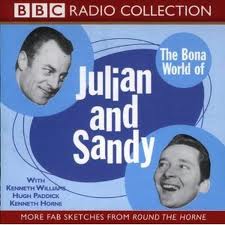 The use of Polari began to wane when society loosened up and male gay sex was de-criminalised in 1967 (interestingly, lesbianism was never a crime). However, before it was finally consigned to the social history books, Polari had one last glorious hurrah. Round the Horne was a popular BBC radio show from 1965 to 1968 and featured short sketches called Julian and Sandy. The high camp comedy was liberally sprinkled with Polari and wicked double entendre, ultra risqué for those buttoned up days. Julian was played by Kenneth Williams and Sandy by Hugh Paddick. The back story here is that the supremely talented Kenneth always struggled with his sexuality and lived an embittered almost monastic existence, whereas jobbing thespian Hugh lived a happy homosexual life with his partner for thirty years. Sadly, both Kenneth and Hugh are now in bona heaven.
A few Polari words such as naff, camp and slap have entered modern parlance. If by chance I walk past you and remark, ‘vada the bona dish’, take it as a complement. And I absolutely love the thought of right wing ranters trolling the internet. I hope they use a wipe-down webcam; forgive them, they know not what they do. The word Polari itself lives on at the Polari Literary Salon launched by Paul Burston (Gay Editor of Time Out London), a brilliant showcase for new gay and lesbian writers.
37.035339
27.430290

 Perking the Pansies